

From fuselage sections and wings, to engines, landing gear and flight-critical subsystems, aerospace components must be moved and positioned with exceptional care. Even the most minor errors in the handling of components can result in costly damage, production delays or safety risks.
As a result, the lifting equipment and solutions used in aerospace facilities are often far more advanced than those found in general manufacturing as they incorporate intelligent controls, advanced safety systems and application-specific designs. Hoists, cranes and intelligent motion control systems are critical to ensuring that high-value components are handled safely, accurately and efficiently throughout their life cycle.
“Hoists play a critical role in aerospace by enabling safe and precise handling of large, high-value components such as engines, wings, landing gear and fuselage sections,” confirms Rob Wood, manager, marketing and business development at Columbus McKinnon Corporation (CMCO). As a global leader in lifting and motion control technologies, CMCO offers engineered hoist and lifting systems to support the manufacturing, assembly and maintenance operations for major aerospace OEMS and MRO facilities. “Our solutions combine precision, safety and efficiency, ensuring compliance with the most demanding industry standards,” Wood adds.
Lifting equipment, therefore, is embedded into nearly every stage of the aerospace value chain. During aircraft manufacturing, cranes and hoists support the movement and positioning of major assemblies along production lines. In final assembly, they enable precise alignment of wings, engines and landing gear. And in maintenance, repair and overhaul (MRO) environments, the lifting equipment must accommodate a wide variety of aircraft types while delivering safe, repeatable handling during inspection and repair activities.
Unlike many other industries, aerospace lifting often occurs in close proximity to personnel performing detailed manual tasks. This then places added pressure to ensure that the lifting equipment offers smooth motion control, predictable load behaviour and advanced safety features. To meet these needs, aerospace facilities typically rely on a combination of electric wire rope hoists, electric chain hoists, overhead cranes, monorail systems and custom-engineered lifting devices. These systems are often designed as part of an integrated solution rather than standalone products. One example of such a solution is the aerospace giant Bombardier, that required an innovative solution to assist the manufacture of composite aircraft wings at its Belfast production plant, where the production area needed to be kept clear and free of gantry crane supports.
Street Crane stepped up to plate to provide three cranes with a lifting capacity of 5t, two with a span of 20m and one with a span of 25m situated between the crane rails. The cranes also needed to be flexible enough to operate in the wide-span bay, which is lightly constructed and built to flex under wind pressure. Street Crane designed a system where, instead of relying on gantry support or using the building columns, the crane rails formed part of the roof structure with gantry cranes suspended from the underside of the tracks and electric wire rope hoists mounted on the crane bridge. This offered a compact design with flexible movement, with accurate positioning.
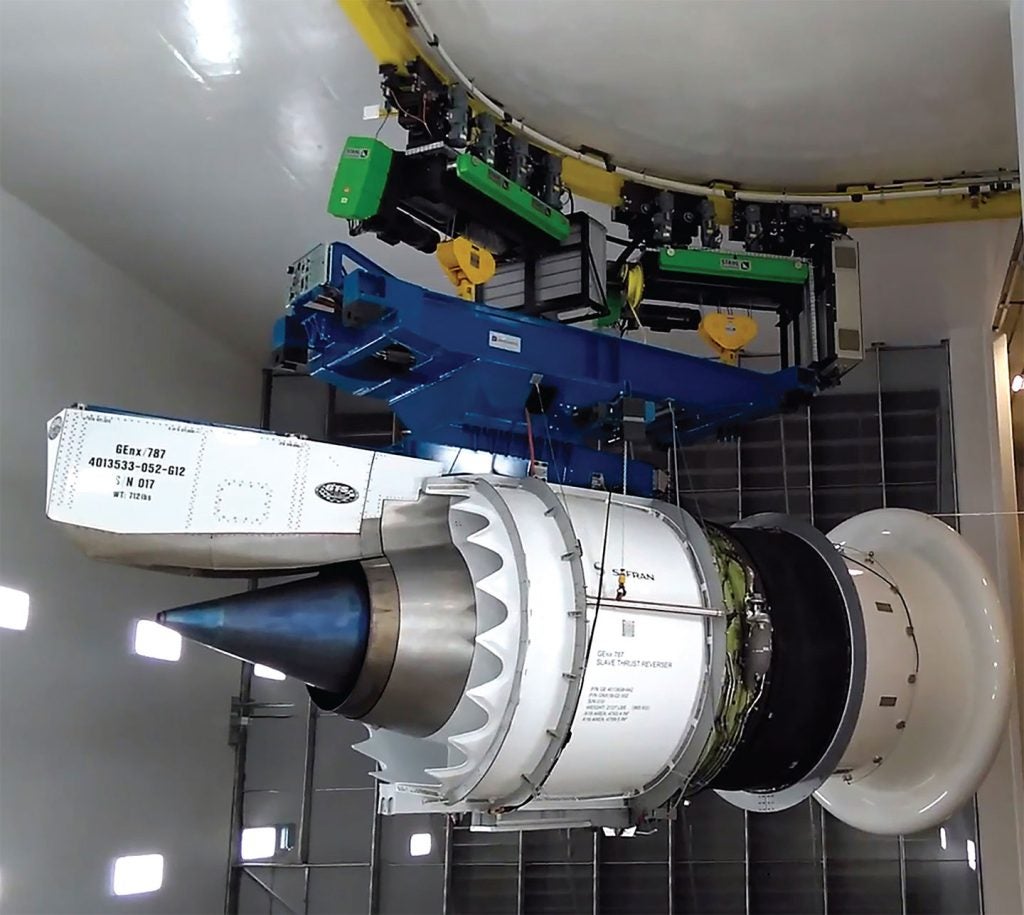
Electric wire rope hoists are essential for the heaviest aerospace lifting tasks – such as engine installation, turbine transport or large structural assemblies, explains Wood. STAHL wire rope hoists such as the SH and AS 7 series, for example, are used widely for heavy-duty lifting. “The latest STAHL developments (for example, SXD and SXF),” Wood goes on to add, “offer compact designs, dual-speed or frequency-controlled performance and advanced motion profiles for exceptional precision.” These hoists provide the load capacity, stability and durability required for demanding duty cycles while supporting advanced motion control technologies. At Street Crane, for heavy lifting or large-scale operations, they also offer cranes with a single span of over 50m to handle large components or multi-span cranes with an overall span of more than 100m to offer comprehensive reach and flexibility for large-scale aerospace manufacturing facilities.

These capabilities are particularly important and crucial when handling aircraft engines and turbine assemblies, where synchronised movement and balanced load distribution are essential to avoid component stress or misalignment. Engine handling represents one of the most demanding aerospace lifting applications. Engines are not only heavy, but also highly sensitive assemblies requiring gentle acceleration, precise alignment, and controlled positioning throughout installation, removal, and maintenance.
Lifting flexibly
While wire rope hoists dominate heavy-lift applications, electric chain hoists are widely used throughout aerospace assembly and subassembly environments. These hoists support ergonomic handling, tooling positioning and repetitive lifting tasks along production lines. “Electric chain hoists from the STAHL ST series provide modular solutions for assembly lines and ergonomic handling in confined spaces,” explains Wood. These hoists integrate easily into monorail systems, workstation cranes and lightweight overhead crane structures.
For many aerospace manufacturers, chain hoists are incorporated into bespoke crane systems designed to support highly specific workflows. For example, Granada Cranes, a UK-based overhead crane specialist, designs and installs tailored overhead gantry cranes, swing jib cranes and monorail systems for aerospace facilities, often integrating variable-speed electric chain hoists and advanced control options.
By combining modular hoists with bespoke crane infrastructure, companies such as Granada Cranes, Street Crane and CMCO help support aerospace operators in achieving both flexibility and precision across complex assembly environments.
It’s clear that to meet Aerospace lifting needs, the solutions are rarely off-the-shelf. Aircraft production facilities and MRO hangars differ widely in layout, ceiling height and workflow, requiring lifting systems that are engineered to fit specific operational needs.
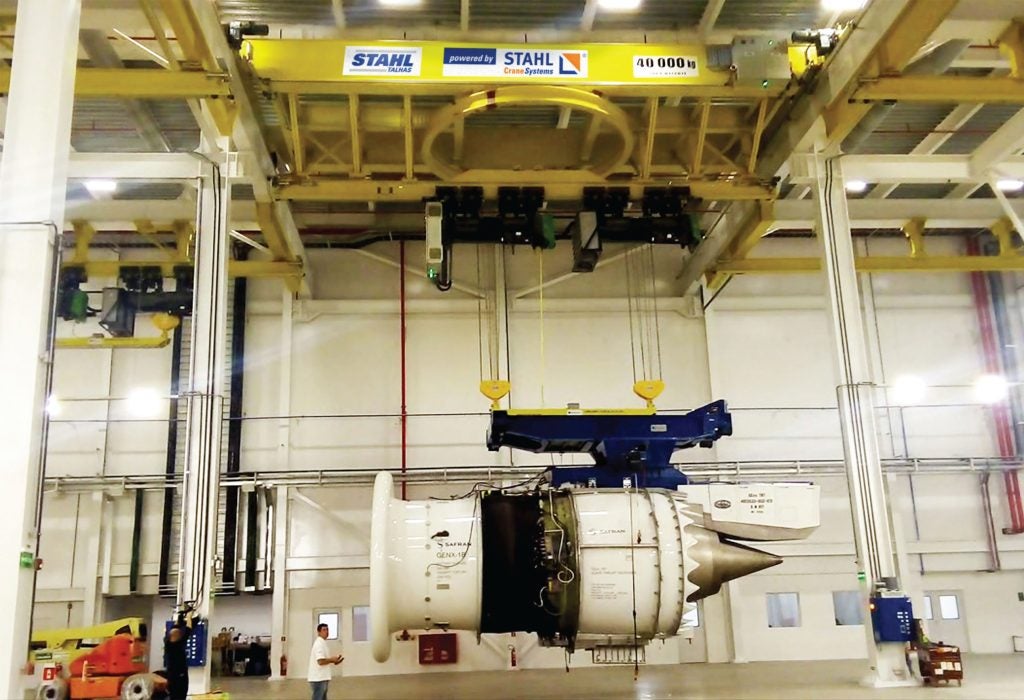
“CMCO,” for instance, “supplies complete crane modules and CraneKit packages for tailored monorails and bridge cranes, as well as screw-jack-driven linear motion platforms for paint shops and docking stations,” says Wood. These systems can be adapted as aircraft programmes evolve, providing much needed long-term flexibility.
Similarly, Granada Cranes specialises in custom crane geometries for aerospace manufacturing, including long-span overhead cranes and complex monorail routes designed to move components safely through congested production halls. These crane systems frequently incorporate wireless controls and variable speed drives to improve operator visibility and safety. At Street Crane, the company also offers custom solutions that incorporate speed drives from load dependent speed, which adjusts the speed based on the weight of the load and enhances control and safety; micro-speeds and infinitely variable speed, which offers precise control over crane movement for delicate and accurate handling; as well as overspeed protection, which safeguards against excessive speeds to protect both the crane and the load. The key benefits of using bespoke cranes for the aerospace industry speak for themselves, offering enhanced precision necessary to complete complex tasks while meeting stringent safety requirements.
Precise and accurate
Precision motion control is a defining requirement in aerospace lifting. “Aerospace lifting differs significantly from general manufacturing due to its demand for extreme precision and repeatability,” explains Wood. “Every component is high-value and often delicate, requiring gentle handling and accurate positioning.”
Sudden movements or uncontrolled acceleration can compromise both safety and component integrity. “Frequency-regulated drives ensure soft starts, controlled acceleration, and creep speeds for delicate positioning, while intelligent integration with Magnetek controls delivers repeatable positioning and real-time diagnostics,” says Wood. In many aerospace crane systems frequency-controlled hoists are also combined with advanced anti-sway functionality and synchronised control logic, improving stability and reducing operator workload during complex lifts.
Modern aerospace manufacturing increasingly relies on advanced materials and tightly controlled processes. Composite structures, integrated avionics and thermal management systems require lifting solutions that support cleanliness, accuracy and repeatability. Major aerospace system suppliers such as Liebherr Aerospace & Transportation Systems design and manufacture critical aircraft subsystems, including flight control systems, landing gear and environmental control systems. The handling of these complex assemblies during manufacture and integration demands lifting infrastructure capable of precise, damage-free movement.
“Safety is paramount,” emphasises Wood, “with overload protection, dual braking systems and ATEX/IECEx options for hazardous zones. Compact, lightweight designs such as the latest STAHL wire rope hoists are particularly valuable in space-constrained assembly areas, offering both performance and flexibility.” Street Crane also offers safety rated controls to ensure compliance with safety standards, plus secondary braking and load arrestors, which offer additional safety measure to stop uncontrolled load descent and secure lifting operations.
Furthermore, compliance with stringent certification and meeting traceability requirements is of the utmost importance – this is especially important considering many operations take place in controlled environments or hazardous zones necessitating specialised protections, sealing and corrosion-resistant finishes.
Safety in the aerospace industry goes beyond the standard requirements, explains Wood. “Operations must minimise sway and shock loads to protect sensitive components and reduce human error.
Redundant safety systems, including advanced monitoring through devices like the SMC 4 multicontroller, provide additional assurance. For environments such as paint shops or areas with explosive atmospheres, EX-protected components and ingress protection are critical to maintaining compliance and operational integrity.”
Intelligence speeding things up
As aerospace manufacturing embraces digitalisation, lifting equipment is becoming increasingly intelligent with condition monitoring, remote diagnostics and predictive maintenance enabling automated workflows, reducing downtime and improving overall efficiency.
“CMCO is at the forefront of this transformation, offering intelligent hoists and control systems that support digital integration and future-ready manufacturing strategies,” adds Wood.
Smart lifting systems supplied by CMCO collects data on load cycles, operating hours, and performance trends. This data supports compliance reporting and allows aerospace operators to anticipate maintenance needs before a failure can occur. At Street Crane, the company also offers condition monitoring that provides real-time data on the crane’s health and performance, ensures proactive maintenance and reliability, as well as Design Working Period (DWP) monitors, which track the crane’s usage and performance to allow for predictive maintenance and reduce downtime. Automation is also increasingly common in high-volume aerospace production environments, where automated crane movements reduce manual intervention and improve consistency. At Granada Cranes, its lifting equipment is integrated into automated systems to provide precise and controlled movement through production facilities, from automated assembly lines to robotic handling systems.
With the rise in high-tech manufacturing, the demand for cleanroom facilities within manufacturing processes grows too, with appropriate lifting equipment required to meet this need. In cleanroom or contamination-sensitive aerospace environments, specialised lifting solutions are required for electronics that need to be made and assembled in a dust-free and hygienic environments. At Hoist UK, the company supplies cleanroom-compatible aluminium gantry cranes designed specifically for aerospace and advanced manufacturing applications. These lightweight, corrosion-resistant gantries support precise lifting while minimising contamination risks, as even the slightest contamination could result in complete equipment failure.
Moreover, outside of a cleanroom, aerospace lifting operations presents other unique challenges: “Aerospace lifting often occurs in tight headroom and congested bays, requiring compact hoists and custom rail geometries. Handling sensitive, high-value parts demands gentle acceleration and precise creep speeds to avoid damage,” explains Wood. “Compliance with hazardous or controlled zone requirements adds complexity, necessitating robust EX-protection and advanced control architectures.” Meeting these challenges requires close collaboration between aerospace operators and lifting specialists.
Looking ahead, the aerospace industry is expected to continue integrating lifting equipment with digital manufacturing environments. Smart hoists, automated crane systems, and connected control platforms will play an increasingly central role. “We anticipate continued integration of hoisting, conveyance and intelligent control systems, with digital enablement and sustainability as key drivers. Aerospace manufacturers will increasingly adopt smart lifting solutions that combine precision, safety, and data-driven performance to optimise production and maintenance processes,” says Wood.
Specialised lifting equipment is fundamental to the safe, precise, and efficient operation of the aerospace industry. From heavy-duty wire rope hoists supplied by STAHL CraneSystems to bespoke crane systems engineered by Granada Cranes and Street Crane, cleanroom-compatible gantries from Hoist UK, and manual aerospace hoists from Yale, lifting solutions must be tailored to meet the industry’s unique demands.
As aerospace manufacturing and maintenance continue to evolve, advanced lifting technologies will remain critical – supporting safety, protecting high-value assets and enabling the precision engineering that defines the aerospace sector.


