

Know the load,” says David Mullard. That is the fundamental reason for load monitoring, and for the devices and mechanisms that allow it to happen. Mullard is just coming up to his tenth year at Crosby Straightpoint, (part of Kito Crosby) where he is business development manager, so he knows his stuff.
“‘Know the load’ means using load cells to measure and stay within the Working Load Limits (WWLs) of your equipment,” he says. “It is one of the easiest ways to improve safety on site.”
But to do that, you do need to know the load monitoring equipment that is available, and which types are best suited for which tasks. They come in a bewildering variety of designs – and of names for the same design. There are, for instance, load cells.
They are also called load links, or tension load cells (as opposed to compression ones) or crane scales or load scales or digital load indicators – DLIs for short – or dynamometers; but not every dynamometer is a load cell and not every load cell is a dynamometer.
Different sources and manufacturers give different definitions, but a quick and dirty (and not totally accurate, because there are exceptions) guide is that a load cell gives an electrical output that has to be sent to and interpreted by some other display unit, while a dynamometer is a self-contained unit that incorporates its own visual display.
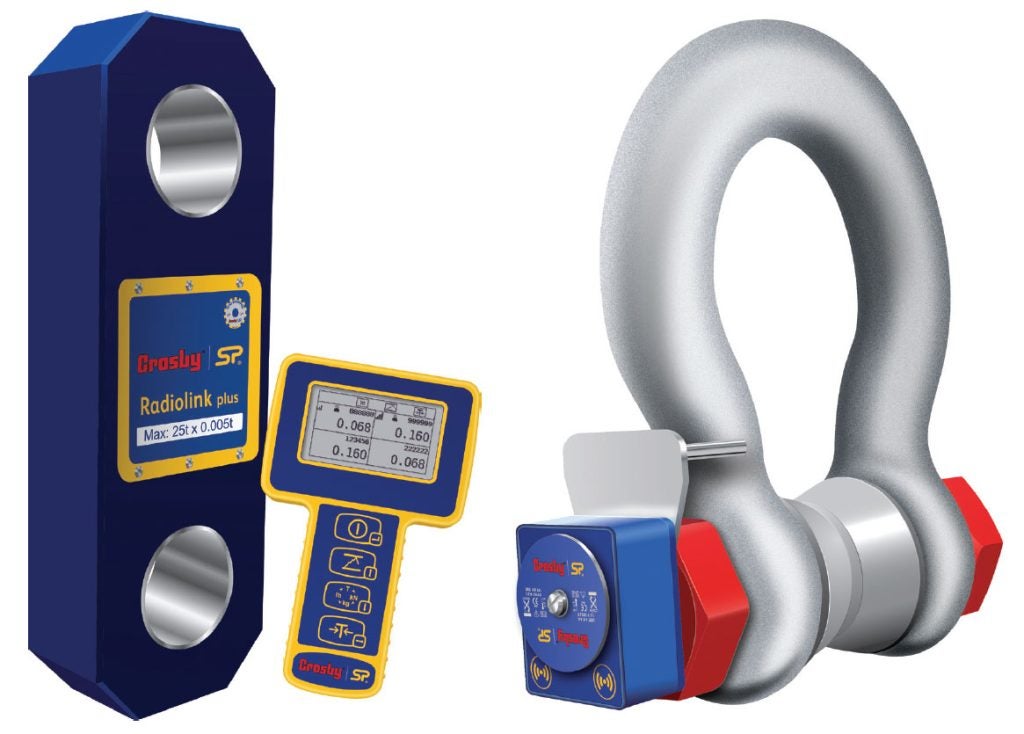
There are also load pins, which are the essential business end of a load shackle; but a load shackle is generally an ordinary shackle with a load pin inserted. Strain gauges are technically the electronic device – essentially a set of fine wires whose electrical resistance changes as they are stretched under load – which is found inside all of the above load monitors and which make them work.
There are also complete overhead crane monitoring systems, which certainly monitor, measure and record the loads on your crane. It can add half a hundred other things as well if you want them to, such as how high that load was lifted, and for how long, and at what speed and acceleration, and the deceleration of the trolley at the end of the run – and whether that was greater than it should have been and whether the operator in question, whom it can quite possibly identify by name, keeps his finger on the ‘on’ button slightly too long each time.
Also the hours that your overhead crane has been in use, the temperature of the motors over time, wear on the brakes, optimum time to the next maintenance for each component, and so on.
Keep it simple
For the moment let us stick to the simpler end of things, the in-line load monitor, be it load cell, load pin, or load shackle. When should you use one design, when should you use another, and what are the advantages of each? Load cells – let us call them that in this article – are conceptually the simplest. They take the form of a metal bar or plate with a hole at each end, and they hang between the end of the rope and the hook, so they take the whole weight of the load. That makes them stretch; they stretch more or less depending on the weight of the load. As they do so, the strain gauges inside them stretch also, and an electrical signal measures that change and sends it back, either wirelessly by radio or Bluetooth, or else by cable, to a readout device.
The body of them is generally made of aluminium: “Aircraft-grade aluminium is a great material for load cells,” says Mullard. “It is very precise, and it returns to its original form when you take the load off.”
The load pin in its load shackle is simpler to attach to your load – it just replaces the ordinary everyday shackle – but its working is less straightforward. The load is applied across the pin, not in line with it, so it does not stretch; instead it bends. This stretches the lower edge of the pin but compresses the upper edge. The strain gauges inside react to this, but not in a linear or straightforward way. Calibration can make the required adjustments; nevertheless, accuracy suffers.
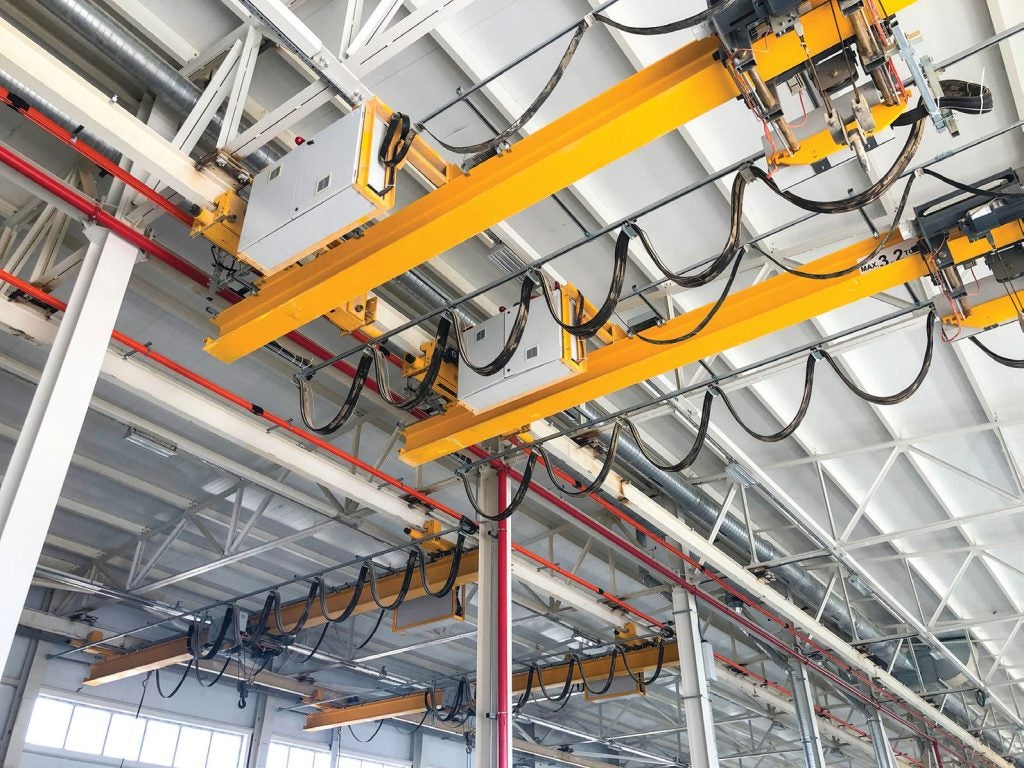
Hence different devices are optimum for different applications. “For precise measurement when lifting, pulling or dragging loads the load link has the advantage,” says Mullard. “The strain gauges inside are stretching in a uniform way to give nice, linear results. If there is a tension force and you need to measure it accurately, and if there is space to fit in a tension link (load cell) and its two (normal) shackles top and bottom, then this is the way to go.” Typically they can give readings to +/- 0.1% accuracy. “There are load cells that can measure up to 25t; measuring that to within 25 kilos is pretty impressive.”
Recommended is to use a minimum of 3% of the capacity of a link style load cell to get results within tolerance, he says. “For the 25t link that would be 75 kilos.”
The length that a load link adds to the drum-to-load distance can be a disadvantage. Where headroom is limited, load shackles come into their own. “They are good for preventing overloads,” says Mullard, “but they are not the most accurate solution. Customers can easily have problems accepting this. They see a load shackle, they like the fact that it is compact, one-piece and looks pretty cool, and want it on those grounds. But if they try to weigh small loads on it, they can easily come unstuck. We recommend using a minimum of 10% of the WLL of a load shackle to start getting results within +/-1%.”
Critical alignment
There is another complication with load shackles: alignment is critical. The pin must be installed in its shackle with one – marked – direction pointing downwards. (There will be some sort of locking device to prevent it rotating within the shackle.) And the load needs to be applied in that same direction, vertically downwards, not at an angle. An angled load or a misaligned pin will result in bending in direction not designed for; the strain gauges inside will give incorrect readings.
Since room inside the pin is strictly limited and access to it even more limited – you have to bore a hole down the centre and working from one end somehow fix everything inside it – load pins require a high degree of expertise on the part of the designer and manufacturer.
“It takes years of experience to get it right and is a bit of a dark art,” says Mullard – and he is speaking there of the normal, limited-angle variety of load shackle and pin. One can only admire the skill that goes into the wider angle variety.

There are also compression cells – you put several of them on the floor, put your large load, say a transformer or something similar on them, perhaps using jacks, and you add up the readings of all of them to give you the total weight of the load. That might not at first sight seem relevant to lifting an object by overhead crane but in fact is highly relevant, possibly essential. Knowing the weight of the load beforehand is essential to planning the lift; and if you know the placings of the compression cells, you – or more likely your software – can work out with great precision the position of the centre of gravity, which again is essential to know before you attempt actually to lift it.
Kito Crosby make Radiolink Plus load cells, which are wireless and transmit to a handheld display that can connect to up to four cells and display the results individually or summed. Their Loadlink Plus is a simple tension load cell with a built-in display – so a dynamometer according to our rough definition above and a configurable built-in alarm that sounds if the load goes above 110% of WLL. Wirelink Plus is similar but with a cable going to the handheld device. “Generally, 90% of our customers choose wireless now, but in certain applications or industries people still choose our wired versions the Loadlink Plus or Wirelink Plus. It can be that there is significant wireless interference in the area, or just that wireless devices are not allowed in such areas,” he says.
Load links and shackles are available for hazardous environments – ATEX certified models, for example, may have more extensive seals to isolate the electrical components within them. They are even available – and in demand – for the extreme environments of metal foundries, where an important application is measuring the weight of molten metal in the overhead ladle that transfers the red-hot liquid from the furnace to the mould; the measurement allows calculation of the correct number of additives to be used. The load cell will of course be located above the hot metal, so must be shielded from the heat as much as possible; as great a distance above the ladle as possible; a thermal fabric jacket for insulation; and a heat shield of steel plate are measured typically used.
A tailored approach
Turning now to overall monitoring, individual crane manufacturers have their own tailored systems. Thus, Konecranes have their Truconnect system of remote monitoring, which collects condition, usage and operating data from control systems and sensors on a crane and provides alerts of anomalies such as overloads. Demag have their StatusControl system, which monitors cranes and hoists, their loads and provides the results as operational data that can be accessed in real time via internet browser on PC, tablet or smartphone. The data is visually classified using signal colours and provides clear information on condition, usage, utilisation, failure risks and service life. Spanish manufacturers GH cranes have their Tecser service technology that connects technicians, customers, machines and the GH data centre, directly through the cloud. It monitors all the service and operating data of GH’s machines, above and below the hook; GH can then perform Big Data analysis and better understand the operating patterns of their machines and the production needs of their customers.
One recent product, from Australia but introduced to Europe only this year (2025), however, is available for all makes of crane, old or new, and can easily be retrofitted to existing installations. From Towne Lifting & Testing, based in Hull, they call it Crane of the Future, or CotF for short, and it is modular: “Six products make up the whole range, but it can be installed in part – say to monitor only crane loads – or in full to give complete coverage of loads, crane performance, operator performance, maintenance and so on,” says commercial director John Elliot.
Crane of the Future can monitor the load that the crane is lifting; it can also do things like automatically reduce the Working Load Limits in accordance with the condition of the crane. The main component is called Liftlog. In its rawest format it is an overload protection device and a monitoring system as well. “It can also set alert functions, for if the crane is overloaded or shock loaded, depending on options that you can select,” says Elliot. “If an overload happens it can send an email, to us or to the customer, so that an investigation can be carried out. It is not just about giving visibility and data analysis: it is about ensuring that the customer is alerted when a problem has occurred.”
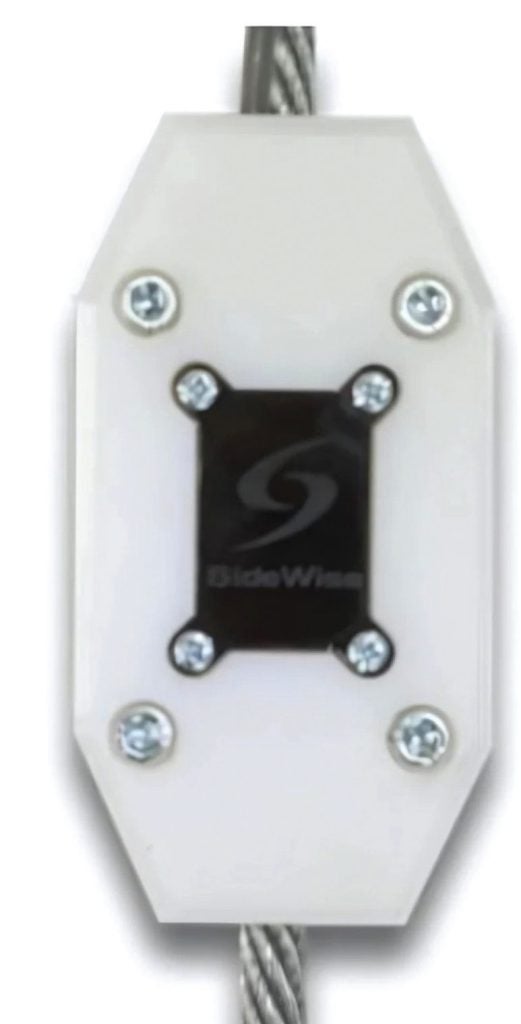
Another of the modules is called SideWise. It provides real-time control to eliminate non-vertical lifts. It is a sensor unit, mounted simply on the rope, that detects out-of-vertical motion – in X and in Y axes, communicates with a signal processing module in the control box as soon as any long or cross-travel horizontal loads are detected and automatically halts motion of the crane. Unlike mechanical devices, however, SideWise will only cut out motion in the direction of the side pull. Separate tolerances can be programmed for long and for cross travel functions.
Unlike conventional side pull prevention tools the system resets instantly once side pulling is corrected. In terms of advanced features, all of the products in the package can connect via a wireless system called Hoist Net, which is a protected Bluetooth network. “From that you can have up to three cranes talking to each other to carry out load summation.”
All this is displayed on a tablet or laptop. It gives a time and a date stamp of every operation of the crane – the load that has been applied, the direction of travel, and so on.
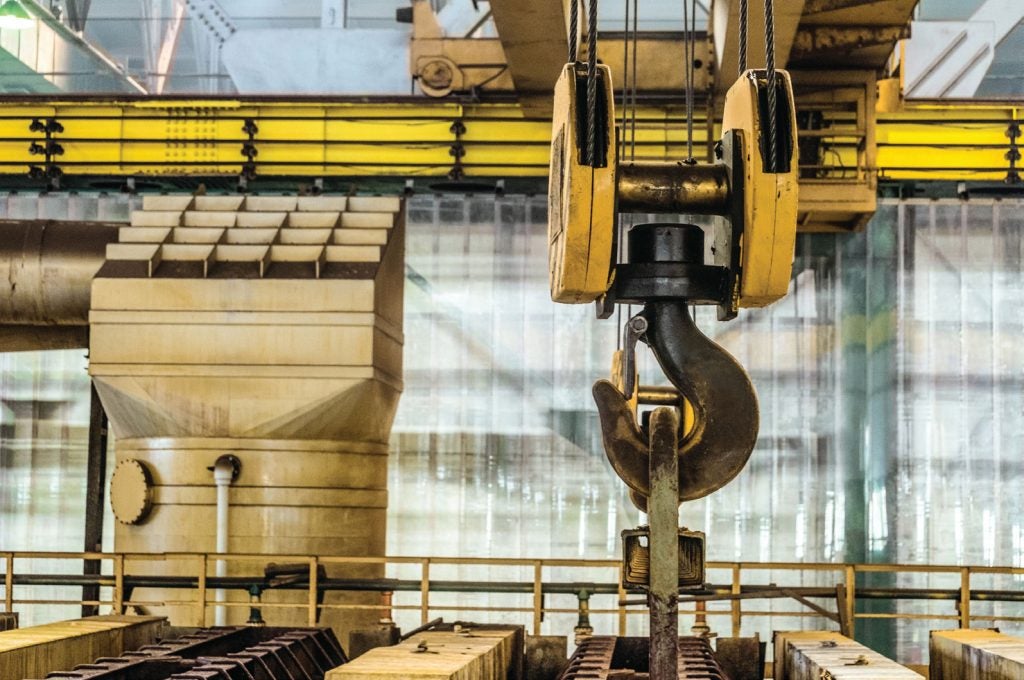
Straight overloading is not the most common cause of problems in overhead cranes. The main source is misuse of the equipment and a lack of visibility on how it being used, in both the short and medium or long terms. Inching, for example – that is, persistently tapping the pendant or remote buttons for short periods – has a significant impact on wear and lifetime of the crane and components. The reports from CotF can clearly show the duration of any button push, so can indicate the problem. Customisable options could include comparisons between shift patterns – so identifying an operator whose technique could be improved, and so increasing efficiency, smoothness of lifts, and perhaps job satisfaction as well. The end result is that breakdowns are reduced, operator performance and safety are increased, and the life cycle of the crane is extended.
“You could say that the hugely increased visibility that Cranes of the Future provides drives a cultural change on the way that overhead cranes are used,” says Elliott. Be that as it may, it is clear that load monitoring is just one part of overall crane monitoring; and with digital technology, not just the weight of the load but the entire lifting operation, indeed the entire operation of the crane over weeks and months can be monitored, recorded, analysed and interpreted as part of a single unified operation. Perhaps, then, Elliott is right: it is a cultural change that has already happened.


