

Sustainability is about more than reducing carbon emissions – important, indeed vital, though that is. It involves the responsible use of the resources of the planet: Tropical hardwoods to be sure, but also, among many other things, less emotive examples such as ores and the metals derived from them, and the energy used in mining, processing and transporting those ores and the products that are made from them.
Fossil fuels need to be phased out; but replacing diesel with electric power requires more electric motors and, therefore, more copper that has to be mined and refined, which is energy-intensive and, therefore, greenhouse gas intensive. For instance, 4.1t of CO2 are emitted for every tonne of copper that is produced, which is more than twice the equivalent figure for steel. (The steel figures themselves are not straightforward.) Electric motors also need magnets, which need rare earths, of which China at present has a near-monopoly; one of the reasons given for President Trump’s desire to acquire Greenland is the unexploited rare-earth minerals on that island. Venezuela is also reported to have extractable deposits. Myanmar is one of the few other sources with rare-earth extraction from there having been associated with human rights abuses and very great environmental damage.
All of which illustrates that achieving – or even moving towards – sustainability is not a simple matter.
Complex calculations and complex decision-making are involved. Compromises may be necessary, as well as changes in behaviour. We could reduce our carbon footprint by simply consuming much less, but are we as a species willing to do that? Throw geopolitics into the mix and it becomes more complex still.
Nevertheless, progress can be and has been made. Measurement is vital in gauging that progress. The energy that a hoist consumes and the emissions that it gives out while in use are only part of the sums. The energy and emissions that are involved in manufacturing that hoist in the first place – its embedded costs – are also relevant, as is the amount of material that can be recycled or that goes to waste when it is eventually scrapped. Lifetime emissions and the circular economy mean exactly what they say.

Energy regeneration
We blithely talk about emissions but a little rigour is needed here. A company’s greenhouse gas emissions are generally measured through three different scopes’. Scope 1 emissions are from activities owned or controlled by the business. Emissions from factory boilers, furnaces and processes taking place in the factory as well as from its vehicles on the road are all Scope 1.
Scope 2 are emissions that a company causes indirectly from sources it neither owns nor controls. Emissions from generating the electricity that it uses fall into this category. Buying ‘green’ electricity (for example, renewably sourced such as wind or hydro) can reduce this. So can making the factory energy-efficient: replacing inefficient lighting with LEDs, installing solar roof-panels and so on are relatively easy to perform and are cost-effective into the bargain – energy-bill savings of 50–70% have been claimed for LEDs, with a return on investment within three to four years.
Scope 3 emissions are those that occur in a company’s value chain. Upstream emissions occur in the supply chain before the product reaches the company – for example, from the extraction, production and transportation of the steel that it fabricates. Employee commuting and business travel are also included. Downstream emissions occur after the product leaves the factory – notably when it is used by customers. There is little point producing, say, a diesel engine emission-free if in every day of its use it emits greenhouse gas.
To put it another way, Scope 1 are emissions directly from the company; Scope 2 are emissions from its supply chain including its energy suppliers; Scope 3 are emissions from the customers using its products.
The challenges, then, of sustainability are not small. How are hoist manufacturers responding to them? The hoisting sector starts with an advantage: Electricity is already the standard power source in permanent overhead crane installations, and indeed is well on the way to replacing diesel in the not-so-easily- achieved sector of mobile and tower cranes, where battery technology is rapidly advancing. Hoist installations are connected to the main grid supply almost by default and regenerative braking – where lowering the load feeds power back into the grid, saving both costs and energy – has long been standard. Morgan Engineering, based in Ohio, manufacture overhead bridge cranes, including charge cranes and ladle cranes. The company says that power regeneration produces roughly 80% of the power required to lift a load when that same load is lowered. During crane travel, about 60% of the power required to decelerate the crane is regenerated and sent back to the grid to power other equipment.
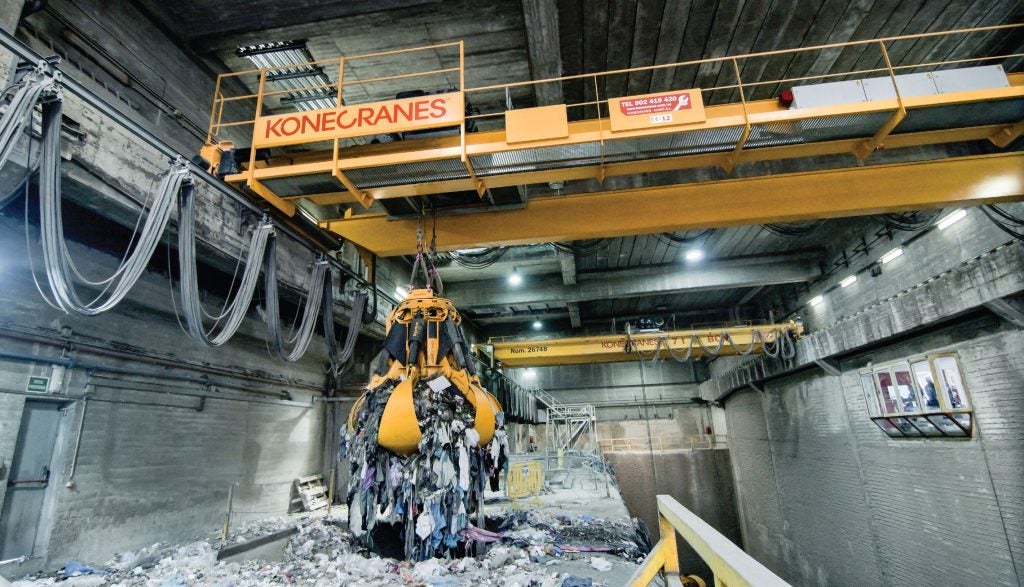
Automation similarly brings huge benefits here: properly programmed algorithms can ensure that every lift is performed with maximum efficiency, and, therefore, with minimum energy use. (In practice, algorithms consider also efficient use of time; the balance between speed of the lift and energy use is one for the company concerned.) “Automation has the potential to revolutionise the way we approach energy use and emissions in industrial operations.
Fully automated cranes in particular are at the forefront of this transformation,” says Morgan Engineering.
Modernisations and upgrades also save energy.
“A focal point of our efforts to contribute to the carbon-neutral goal is our commitment to crane modernisation,” says Morgan, “specifically through DC to AC conversions. AC technology not only enhances the operational efficiency of our cranes but also significantly reduces power consumption – by as much as 72%.” Converting the DC cranes of one of America’s largest steel facilities to AC saved the company around $125,000 per crane per year.
The company practiced what it preached in reducing its own Scope 1 emissions: “We recently upgraded our largest crane in Morgan Engineering’s shop with AC technology, which gave us the benefit of regenerative electricity and allowed us to update the controls, making it easier for our crane operators to use it. This is a significant milestone in our journey towards sustainability in manufacturing.”
Circular economies boost sustainability

“Within the circularity field, there is so much you can do because the topics vary from minimising waste to creating or innovating new business models,” says Anniina Virta-Toikka, vice president for sustainability at Konecranes. “So I think that if we want to take the circular consideration holistically, we should start from portfolio management. Because there the decisions are being made on what do we actually offer and what direction should we bring to our offerings?
“The focus or spearhead for us is climate ambition – to reach the net-zero target in the long term and the -50% 1.5 aligned climate targets by the end of 2030. Any unavoidable emissions remaining after that time will be fully offset. The role of circular economies is really, really big for us.”
Circularity principles start at the product design stage, she says. Konecranes use a concept called ‘Design for Environment’. It has a clear target: the environmental impact of each new product design must be reduced from that of the previous generation.
Thus, Konecranes’ updated S-series synthetic rope hoist is 20% lighter than its predecessor and 94% of its materials are fully recyclable metals. Konecranes have reduced the transport emissions of their large overhead cranes by a structural design that allows the main girder to be transported in two pieces on just a single truck, thus making one journey instead of two.
“We need to ensure that the equipment we are selling is maintainable and repairable,” says Virta-Toikka. Modularity is a part of that. Konecranes particularly apply it to batteries. “As we all know, battery technology is rapidly changing and improving, so we are designing products so that new technology can be retrofitted as it becomes available,” she says.
Konecranes is also tackling its Stage 1 emissions.

“There is environmental management within our own manufacturing – ensuring that we make efficient use of raw materials and resources as well as managing the waste. In Finland, they have shifted to fully renewable district heating and renewable fuels; in Sweden they replaced oil-based heating with geothermal heating.
They are also continuing to electrify their vehicle fleet.
“Efficient use of raw materials” in the above paragraph means, for example, using less steel in the design of a new product. Current steel production is emissions intensive and accounts for 7% of global greenhouse gas emissions. The carbon footprint of steel is 1.4t CO2 to 1t steel produced (according to the IEA), and 1.85t according to McKinsey and the World Steel Association. (It is a complicated sum because there are two main production methods for steel in the world. The Blast Furnace-Basic Oxygen Furnace route has a footprint of 1.987; the Electric Arc Furnace route uses a proportion of recycled steel to give 0.357t of CO2 per tonne of output steel, a saving of 1.787t. The 1.85 figure is a weighted average of the two.) The impact of transport on the carbon footprint of steel is estimated at 7.9g per tonne-km.
Decarbonisation of steel production is possible, and some efforts to that end are under way. It is possible to produce it with a carbon intensity of just 0.2t CO2 per tonne of steel (technically, the method uses hydrogen reduced electric arc furnaces powered by renewable energy) but the method costs more: its steel would need to command a “green premium” of about 20% over 20 years to fund construction of the plant and infrastructure. Again, business decisions are needed: are we willing to pay the extra costs?

Lifting ourselves out of danger
So using less steel in your hoists is one route to sustainability. Another is to make your hoists last longer, so that they need replacing less often and to design them so that when they are ageing, it is possible to replace only the parts that are actually worn out, retaining the rest. Bearings and the like can be expected to wear out; the brute steel girders will last much longer.
“We can modernise an old diesel-driven port crane that has been in place for 20 years so that it becomes fully electrified – which means that you don’t have to replace the tonnes of steel structure, you only replace the technology,” says Virta-Toiikka. Remanufacturing also offers room for ingenuity and manoeuvre.
Austrian-based Kuenz Cranes also believes that sustainability starts at the design stage. “There are many ways to a more sustainable crane,” says Philipp Gmeiner, product manager of crane systems at Kuenz. “It starts with choosing a suitable crane concept in close collaboration with the customer and operator. It makes an analysis of the whole structure by experienced engineers, with the latest calculation and simulation methods.” Smart use of today’s computational power makes it possible to analyse and simulate the structure in detail. “That leads to optimised weight of components and still secures high performance and high stiffness of the structure.”
Kuenz favours regional suppliers to keep transport distance to its production sites to a minimum; the same is true for the transport distance between productions sites and customers. “Our core market is container cranes in Europe, which perfectly suits the location of our production sites in Austria and Slovakia and, therefore, reduces transport emissions and time,” he says.
Kuenz’s unique gantry crane design also reduces emissions. Its main feature is the aerodynamic shape of the main girder, the top part of the crane that is directly exposed to wind. “Wind is an element that increases the energy consumption of a crane. It is, therefore, important that the effect of wind on a crane is reduced as much as possible,” says Gmeiner.
“The effective wind surface on an aerodynamic crane is reduced by around 50% in comparison to a conventional box girder design. This effect has been calculated and simulated with the help of CFD simulations (Computational Fluid Dynamics) and wind tunnel experiments, something that is only possible with today’s computational power. As a result, the power demand of the gantry drives is reduced by up to 35%, which leads to a lower energy consumption of the cranes.”
The design is in use on Kuenz’s rail mounted gantry cranes, automated stacking cranes and rubber-tyred gantry cranes. But it is not only the aerodynamic girder that has been adjusted. The design weighs around 15% less than a conventional double box girder design – so uses less steel, and has reduced dynamic wheel loads. “The supporting structure under the crane tracks can be built more easily and more sustainably. Lower wheel loads can reduce the amount and time of the construction work as well as the amount of concrete and steel,” says Gmeiner.
The bottom line is that we are all involved in sustainability, whether we are manufacturers, users or simply bystanders. We all inhabit the same planet, and it is the only one that we have. Using less, and using what we have efficiently, is the responsibility of us all.
Crane Move Saves Waste

Unipart Power Drive recently faced a common challenge: What to do with perfectly good equipment that is no longer needed in its current location. In this case, it involved two gantry cranes – a 5t and a 10t model – situated at their Cosham site near Portsmouth. A site repurposing project was under way, and the cranes were surplus to requirements. However, Unipart demonstrated a commitment to both cost-effectiveness and environmental responsibility by choosing a sustainable alternative to disposal.
Rather than scrapping the cranes, they identified an opportunity to reuse them at their Coventry manufacturing facility. Expansion plans there created a need for precisely the lifting capacity these cranes offered. The forward-thinking approach avoided unnecessary waste and significantly reduced capital expenditure.
Lifting Systems of Northampton was selected to manage the complex process of relocating and refurbishing the cranes. The team began by carefully and methodically dismantling the cranes at the Cosham site. Each part was carefully catalogued and prepared for transport to Lifting System’s Northampton facility where the cranes underwent a complete reconditioning process. This included a thorough inspection of every component, identifying any necessary repairs or replacements. The cranes were brought up to optimal operational standards. A fresh coat of paint improved the cranes’ appearance but also provided a protective layer against future corrosion. This comprehensive refurbishment process extended the operational lifespan of the cranes, maximising their value and minimising the environmental impact of manufacturing new equipment.
The project’s success is a clear demonstration of the financial and environmental advantages of asset repurposing. Unipart Power Drive achieved substantial cost savings by avoiding the expense of purchasing new cranes. The sustainable solution aligned perfectly with their commitment to environmentally conscious business practices, reduced waste and minimised their carbon footprint. The repurposed cranes seamlessly integrated into their Coventry operations, immediately adding value to their new facility.
Remanufacturing saves resources
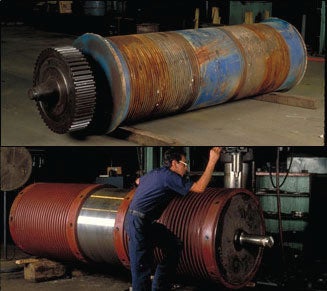
The rope drums used in heavy-duty hoists suffer hard use and near the end of their life cycle may develop grooves from the wear and tear of the rope. A new replacement drum is an option, but Konecranes will offer to remanufacture the existing drum as a quicker and greener alternative.
Konecranes’ remanufacturing process begins with pre-machining the drum to flatten the grooved area. Filler welding follows: this can be done with great precision and creates an even surface.
The speed of the process is a clear customer benefit from remanufacturing. There are others. Compared to manufacturing a new component, remanufacturing an existing one reduces the carbon footprint: in the case of the rope drum initial calculations show a reduction of nearly one-third. “Remanufacturing reduces raw material usage and potentially climate impact. The sustainability benefits are visible both on a component and the crane level, and for the customer operating it,” says Antti Kivari, Konecranes’ vice president of global parts supply.


