

Rail-mounted gantry cranes (RMGs) and rubber-tyred gantry cranes (RTGs) fulfil key roles in terminals, handling every container on arrival and departure. Straddle carriers offer additional mobility, moving goods in areas where a stationary gantry crane cannot go.
Huge demand for these products continues to fuel innovation, as manufacturers seek a competitive advantage. New entrants also continue to emerge.
New entrants
Turkish crane manufacturer BVS Cranes launched an RMG range last year, with the first units delivered to German rail terminals in September.
“For BVS, 2025 has been a highly valuable and strategic starting year for the RMG product group,” says Akın Onder Topuz, business development and marketing manager.
“Following these initial implementations, our focus has shifted to the global rollout and commercialisation of BVS RMG solutions.”
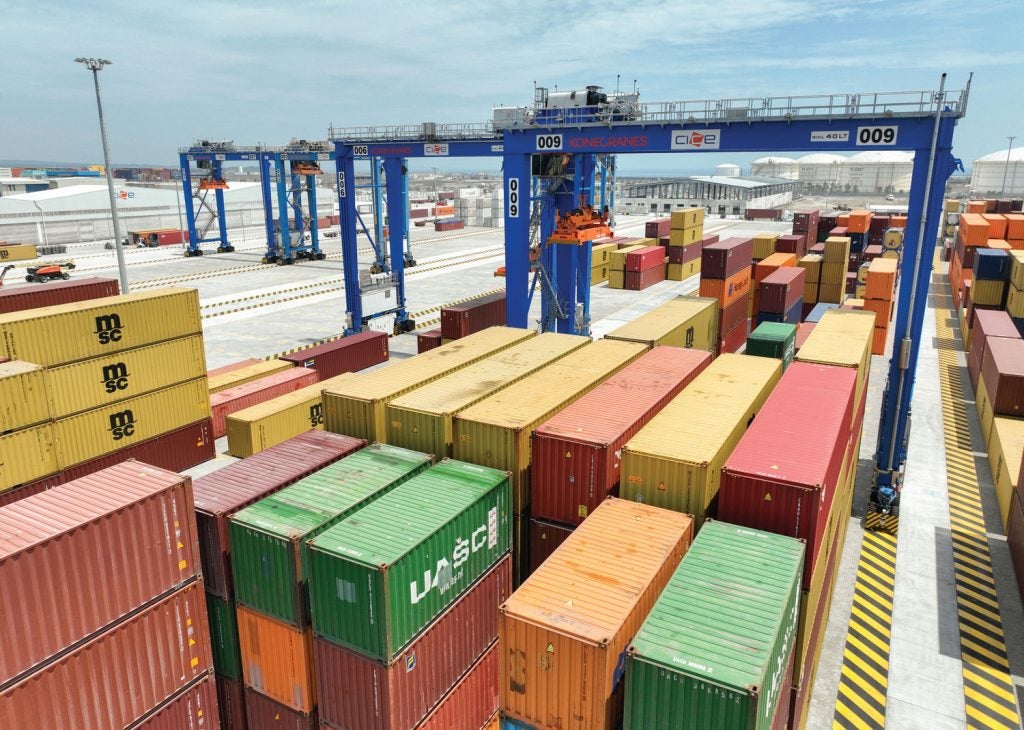
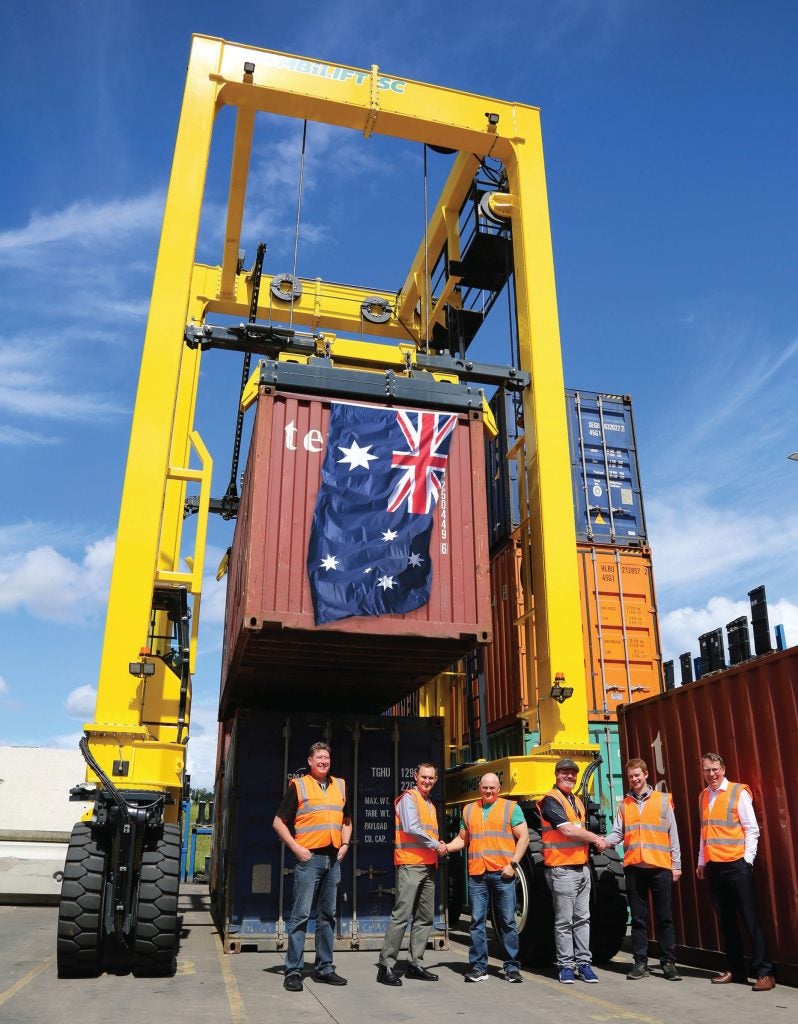
Meanwhile, Irish manufacturer Combilift, known globally for its multidirectional forklifts, has entered the straddle carrier segment. This began in late 2023 after Australian container handling company FBT Transwest approached Combilift for a bespoke solution.
“The Australian company approached us seeking a solution to optimise storage space and stack containers three high while maintaining a safe environment, and the COMBI-SC 3-HIGH Container Handler is the result,” Combilift says. The model features a telescopic top lift attachment and telescopic function, enabling it to triple-stack containers.
The Combi-SC 3-High Container Handler delivered faster turnaround times and improved storage capacity for FBT, along with greater comfort for drivers. One of the standout features is its four-axle with eight-wheel design, ensuring low ground pressure and high stability, allowing it to operate effectively on various surfaces without causing damage or the need to resurface.
The machine also features all-wheel steering, two-wheel drive and two-wheel braking systems, along with heavy-duty solid tyres with dual wheel assemblies for high manoeuvrability and control in confined yard spaces. Safety features include an enclosed operator cabin, adjustable lift speeds based on load weight, and larger windows for enhanced visibility.
Late last year, Combilift followed this with its first 2-High Shuttle Express Straddle Carrier for a port operation. Designed specifically for fastpaced environments, the 2-High Shuttle Express is equipped with a high-mounted operator cabin that offers superior visibility, comfort and space – key elements for operators managing speeds of up to 15mph. “This elevated cabin design enhances safety and control during rapid manoeuvres in busy terminal settings,” Combilift says.
“A standout feature of this model is our patented telescopic lifting system, enabling double-stacking of containers. This innovation significantly improves yard capacity and operational flexibility by optimising vertical space – an increasingly vital asset in busy yards and ports.”
asset in busy yards and ports.
Range refresh
In 2025, Liebherr Container Cranes marked 25 years of RTG innovation with the relaunch of five RTG models, including two fully electric cranes. The RTG-CB has a continuous power supply, requiring fixed conductor bar infrastructure, while the ERTG-CRD runs on a flexible power feed, utilising a reeling drum for cable management.
They are joined by three hybrids, starting with the RTG-HC, which uses super-capacitors for energy recovery in combination with a smaller diesel generator. Liebherr says it offers the lowest capex investment and fastest pay-back period for a hybrid system. The RTG-HB is a diesel-electric crane, utilising battery energy storage, and is designed for optimal fuel saving and emissions reductions. The third hybrid is the RTG-VSG that Liebherr says is a fuel-efficient diesel RTG.
“This range of Liebherr RTG models are defined by their flexibility, sustainability and future ready design,” says Trevor O’Donoghue, head of marketing.
“Liebherr’s proprietary energy modelling and simulation software, which predicts customers’ fuel and energy consumption based on real operating conditions, allows for comprehensive technical and economic assessments, ensuring each customer is matched with the optimal RTG model for their specific operational and environmental objectives,” adds O’Donaghue.
Meanwhile, Chinese manufacturer ZPMC has recently unveiled three new products: the Ultra-High Automated Empty Container Handler, the Model-S High-Speed Rail-Mounted Gantry Crane (RMG) and the Modular Standard Rubber- Tired Gantry Crane (RTG).
The Model-S Series RMG achieves a gantry travel speed of up to 300m/min. Combined with low energy consumption and a lightweight design, the company says this leads the way in efficient and green operations. First deployment will be for a terminal in the Philippines.
Compared with conventional models, ZPMC says wheel loads are reduced by 15%. “This means reduced ground pressure, making it suitable for more types of ground conditions while also cutting down damage to terminal infrastructure,” it adds. “Energy consumption is 10% lower than that of conventional models, achieved through energy saving design and advanced drive technologies.”
With the Modular Standard RTG, it is all about supply and demand. “Through standardised design and modular production, the Modular Standard RTG shortens the delivery time by 30%,” says ZPMC. “With comprehensive functionality, reliable quality, and timely service, it provides customers with cost-effective, tailormade solutions.”
ZPMC’s ultra-high automated rail-mounted gantry crane for empty container handling has a high-density stacking capability of ‘stack 8 over 1’, enabling containers to be stacked up to the height of an eight-storey building. Within the same yard footprint, container stacking capacity can be increased by over 30%.
Its electrical control system is capable of automatically detecting the spatial relationship between the spreader and containers during automated empty container stacking, thereby optimising stacking paths, enhancing terminal space utilisation, reducing labour costs and supporting more efficient terminal operations.
The product integrates intelligent double collision avoidance technology combining vision and laser systems, and is equipped with an advanced twist-lock detection system as well as a truck anti-hoisting protection mechanism, forming a multi-layered, all-round safety protection system. It was successfully deployed in 2025 at the PNC terminal in South Korea.
“This system significantly enhances terminal operational safety and ensures stable and efficient operations,” adds ZPMC, highlighting its design rationale.
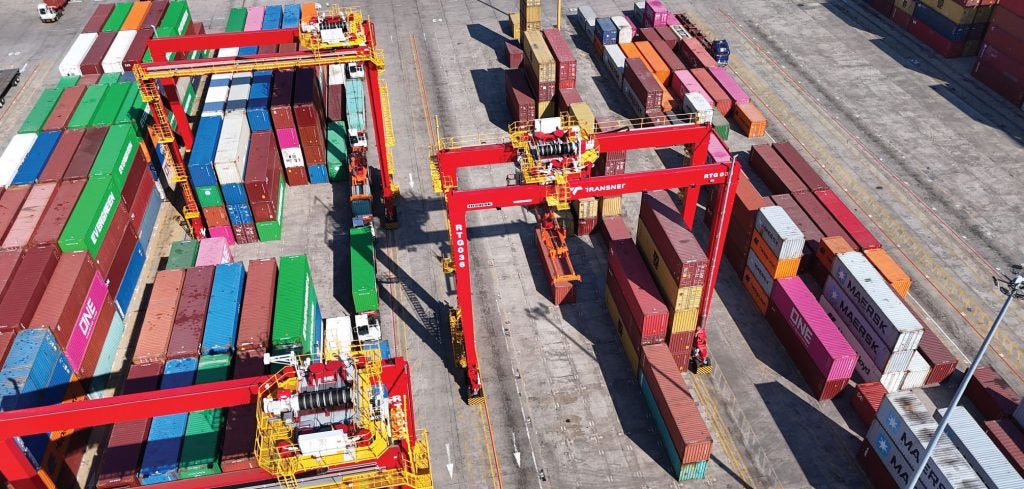
The most important development with Konecranes’ RTG series was the introduction of its E-Hybrid power option. This combines traditional grid power supply with onboard batteries. “This brings the beneficial possibility of all-electric operation to container terminals, something especially critical to those that suffer from blackouts,” the company says. “This power option has proven very attractive in the market.”
It has a maximum power demand of 60kW, a fraction of the 400kW traditionally required. Konecranes launched the E-Hybrid RTG at TOC Europe last June. All versions of the Konecranes RTG are available with a wide range of smart features that incorporate automation and operator-assisting technology. “It is possible for customers to build a fleet of Konecranes RTGs up to fully automated operation in manageable steps,” the company adds.
In addition, Konecranes offers the electric anti-sway EAS RTG, which uses DynaPilot technology to minimise container sway. “This crane is popular in developing markets because it combines a simplified design with excellent reliability,” it says.
Key differentiators
While competition is increasing, OEMs still have their own USPs. “Konecranes RTGs and RMGs are recognised by container terminals as premium, high-performance, reliable cranes with an excellent pedigree, all power options, and a growth path to full automation,” the company says. “Konecranes is a pre-eminent global, western supplier.”
Konecranes also points to its ‘Core of Lifting’ technology, a proprietary package of gears, motors and controls that are designed and manufactured in-house. It also offers an active load control system, which it says is the key to a successful transition to fully automated RTG and RMG operation.
Automation is also part of Liebherr’s portfolio. “Liebherr’s Remote Operator Stations (ROS) enable precise, consistent crane movements while reducing operator fatigue and on-site safety risks, supporting both semi and fully automated terminals,” says O’Donaghue.
This remote operator system enables crane operators to control multiple cranes from an ergonomically designed office environment using high-definition video, intuitive controls and advanced assistance functions. It is combined with driver assistance systems such as truck anti-lift, truck positioning and soft-landing.
“These automation and remote offerings help terminals optimise workforce output, enhance safety, and future proof operations in an increasingly digital and automation driven industry,” adds O’Donaghue.
For Liebherr, another key differentiator is its track record. “Liebherr RTGs are recognised for their proven reliability within the global container handling industry, underpinned by long term operational performance at some of the world’s most demanding terminals,” says O’Donaghue. A good example of this is King Abdullah Port, where Liebherr supplied its first RTG over 12 years ago. Since that initial delivery, the fleet has expanded significantly with 68 Liebherr RTG cranes now in continuous operation.
“This sustained expansion is a clear demonstration of customer trust in Liebherr’s engineering quality, reliability and life cycle performance,” adds O’Donaghue. “The ability of Liebherr RTGs to operate reliably over many years in a high throughput environment reflects robust design, high quality components and a strong focus on uptime and availability.”
For several manufacturers, including Liebherr, flexibility is also vital. Liebherr RTGs provide flexibility through a wide choice of power options that can be ailored to each terminal’s operational strategy, infrastructure and sustainability objectives. “Rather than offering a one size fits all machine, Liebherr provides electric, hybrid – capacitor and battery – and variable speed diesel RTG options, allowing operators to select the most appropriate technology for their current needs while retaining the ability to adapt for future requirements,” says O’Donaghue.
“Liebherr RTGs can be configured to match local power availability, operating patterns, space constraints and regulatory requirements, making them sustainable and flexible option.” Rather than enforcing standard models, BVS adopts an engineering-driven approach. Critical parameters such as special spans, wheel loads, and rail gauges are engineered on a project specific basis for each customer.
“This flexibility is one of the key factors that differentiates us from our major competitors,” says Topuz. “The fundamental philosophy behind BVS RMGs is not to impose a standardised product, but to directly translate the customer’s operational requirements, site conditions and future growth plans into the engineering design.”
BVS Cranes’ remote monitoring, condition monitoring and digital twin applications were first deployed, validated and matured in the heavy-duty crane segments before being integrated into its RMG and RTG product lines.
The company has manufactured more than 30,000 of these cranes, gaining decades of engineering experience.
ZPMC’s focus is on deep integration between automated controls and mechanical equipment.
“This not only maximises the equipment’s efficiency and performance but also reduces energy consumption and mechanical wear on equipment components,” it says.
In addition, ZPMC offers intelligent operation and maintenance (O&M) management systems, providing life cycle management for terminal equipment. “Customers choose ZPMC not only for stable, reliable and high-performance products, but also for our comprehensive services throughout the entire life cycle,” it adds. “This ensures users feel genuinely supported throughout their entire equipment usage experience.”
For Combilift, key features of its Combi-SC include lightweight design, meaning it can operate on gravel surfaces. In addition, its compact design means it can operate in aisles as narrow as 1.6m. With productivity a key performance indicator in yards and terminals, it offers two-minute off-loading from trailer to ground. “This results in faster loading times without the need for trailers waiting during the loading or offloading.”
Demand drivers
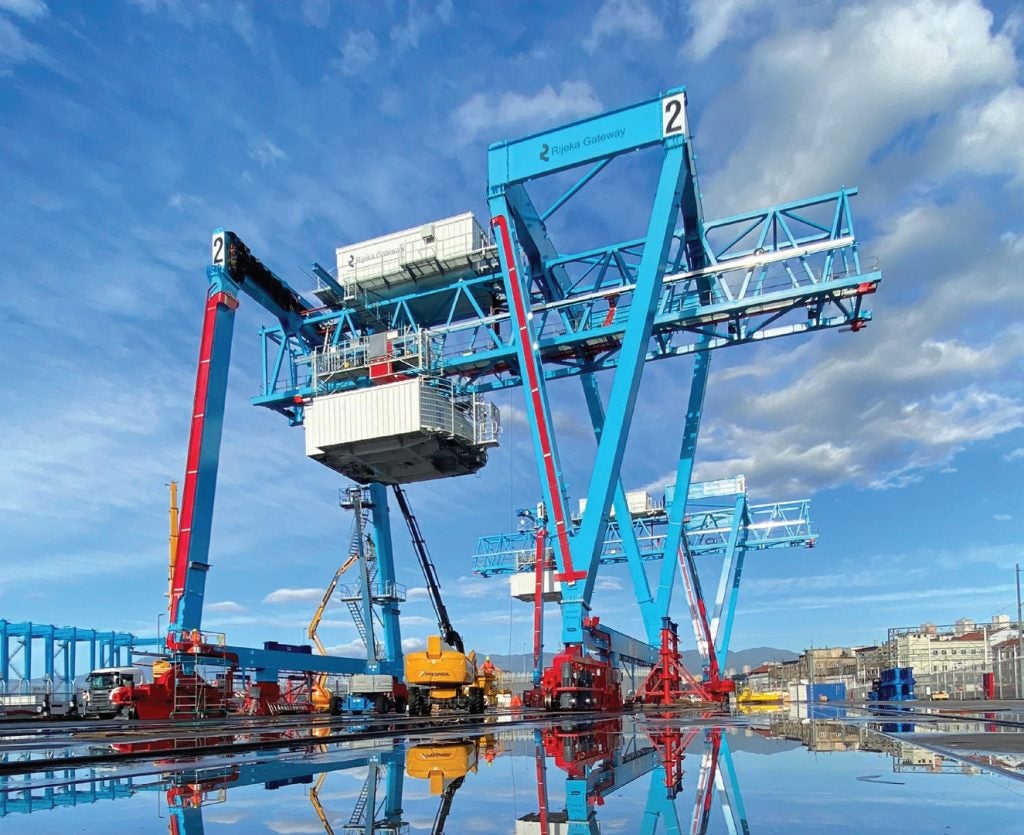
Demand for Liebherr RMG and RTG cranes remained strong throughout 2025, with the company reporting a steady order intake for the year ahead. “Liebherr has continued to build on long standing customer partnerships, with repeat orders reflecting confidence in the reliability, performance and life cycle value of Liebherr stacking cranes,” says O’Donaghue. It has also expanded into new and developing markets, gaining momentum in North America, where it says demand for modern, energy efficient container handling solutions has increased. BVS sees RMG growth coming from new rail terminals, inland waterway transportation, major port investments and both greenfield and brownfield projects. For RTG, it also cites the US as a key focus, along with southern and western Europe, Turkey and the Middle East.
However, Konecranes notes that Asia is still the largest market for container handling equipment and will continue to be for the foreseeable future. “RTGs are established as the core crane of container handling in a large segment of the world’s container terminals, Asia included,” it says. “Investment in these terminals occurs according to the ebb and flow of container traffic in the world.”
Because the RMG is primarily an intermodal crane for container handling with trains and road trucks, demand is concentrated in areas experiencing intermodal development and expansion. Interestingly, RMG operators are therefore not pushing as hard for automation.
“Automation in intermodal container handling is coming more slowly than in the large seaside container terminals for many reasons,” says Konecranes. “The main one being intermodal terminals are smaller operations, and their container handling cycles are less predictable.”
demand continues its upward trend.
Steady growth
2025 was a strong year for many OEMs. At the end of November, ZPMC delivered 18 RTGs to the RSCT terminal of Sokhna Port in Egypt – the country’s first fully automated terminal. The RTGs are equipped with spreader detection and target detection systems, combined with a new automation platform. ZPMC says this comprehensively improves the efficiency and stability of automated operation. They have a hybrid power system, combining sliding contact lines and lithium batteries.
Hutchison Ports’ RSCT project in Egypt is Egypt’s first fully automated terminal. With a 2,600m-long quay and a total area of 1.6 million square meters, it will become Egypt’s largest container terminal upon completion. Designed to handle 3.5 million TEUs annually, it can accommodate ultra-large vessels up to 400m long. In addition, RMGs and RTGs were part of Liebherr’s huge contract with Transnet Port Terminals in South Africa. The deal includes a 10-year partnership agreement and 20-year asset management programme.
Transnet has ordered 48 RTG cranes for its Durban and Cape Town terminals, and several units have already entered service. They will be followed by RMGs for intermodal operations, along with port cranes. Beyond the supply of cranes, the 20-year asset management programme includes maintenance, repairs and parts management. Liebherr will provide local parts and service engineers from its new distribution centre in Durban and upgraded customer service facility in Cape Town.
However, the watchword for 2026 seems to be steady growth. “In 2026 Liebherr Container Cranes looks forward to seeing yard crane demand steadily continue,” says O’Donaghue.
“This demand is shaped by terminal operators accelerating demand for sustainable, automated operations that lower emissions, improve operational productivity and support long term digitalisation efforts.
“Liebherr’s electric and hybrid RTGs and remote operated RMG cranes meet this demand as flexible, future ready assets. Another influencing factor of Liebherr’s 2026 outlook is the growing demand for remotely operated RTGs and RMGs using Liebherr’s Remote Operator Stations, reflecting customers’ focus on enhanced safety and operator efficiency.”
Topuz agrees. “We foresee 2026 as a strong and promising year for BVS, with an increasing number of RMG projects and potential RTG opportunities.”


