

Overhead cranes need operators. Operators need to be trained. Training a student takes time and practice; and all the time that the student is learning on an overhead crane, he or she is occupying the said crane. This means that it is unavailable for its full-time job of moving loads around the plant at full speed and high efficiency to keep production going, the factory functioning, the end product in actual production and the whole enterprise operating and profitable. There used to be no real way round this.
There is now. Virtual reality, or VR, can make digital models of the crane and its operations; students can train not on a real-life expensive crane but on a screen or a panel of screens in front of them, or even by wearing a set of VR goggles. Simulator training began with hesitant steps in the early 2000s. It has progressed since then, in affordability, in the realism of the experience and in popularity. The advantages are many and clear.
Gaining an edge
First, as we have said, it frees up the real crane for its proper use. Second, it gives the student as much unlimited time as he or she needs to learn. Third, the lessons are repeatable, standardised exercises that can be practiced as many times as needed and that give results that can be objectively assessed by the system as well as by a human instructor. And fourthly, all of these factors make for great economies for the employer who needs to train new operatives.
“Suddenly, there was an option that made training faster, more affordable, and – most importantly – safer than any other approach to date,” says Danial Alizadeh, chief product officer at CM Labs, who have been making such systems for more than 25 years. Even the early versions, he says, gave significant improvements over traditional training methods.
Productivity increased and so, interestingly, did recruitment efforts. If operating cranes seemed an old-fashioned job, dirty and noisy and failing to attract youngsters (which it most certainly was, with a notable shortage of new recruits having been recently visible in the sector) then making it digital, even just in the training stages, made it much more attractive to the generation that has grown up in front of computer screens.
Since then, advances in computer graphics, processing power and display technology have enhanced the capabilities of such systems. One such system is from CM Labs itself, which has recently introduced a new generation of training technology known as Intellia.
It is tempting to think that the technology – the video screens, the VR simulations of cranes moving at trainees’ command in accurately reproduced digital surroundings – is what simulator training is all about, but that’s not so. “I’d like to start by saying that we do not build simulators,” says Alizadeh. “What we build are workforce training systems. The simulator itself is just a component of what we do.”
Different tools for different goals
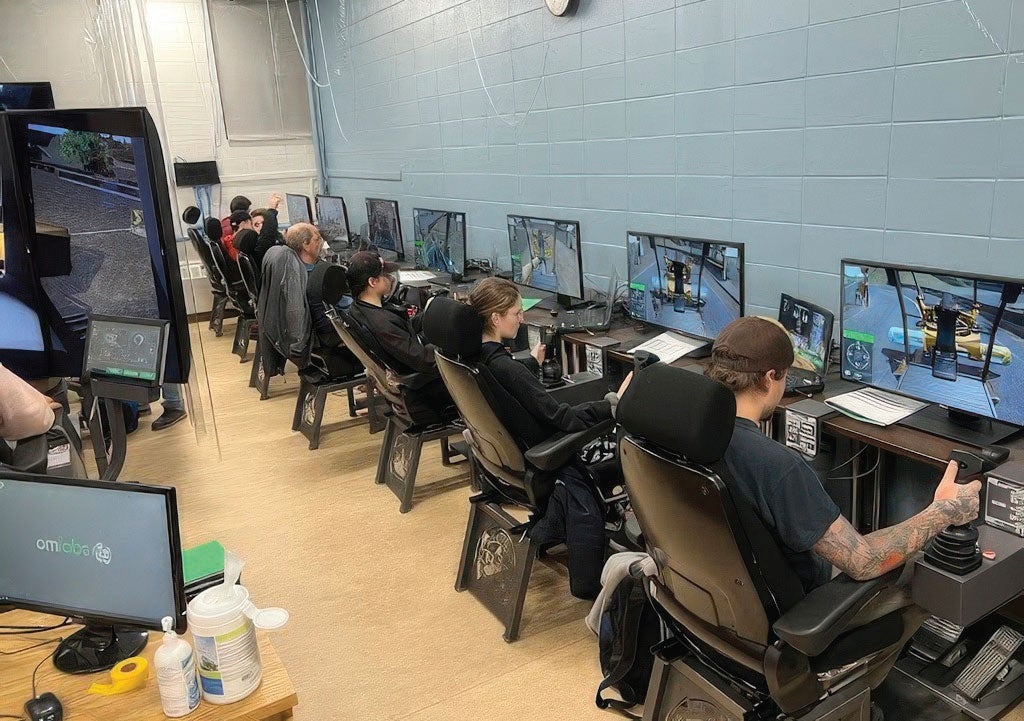
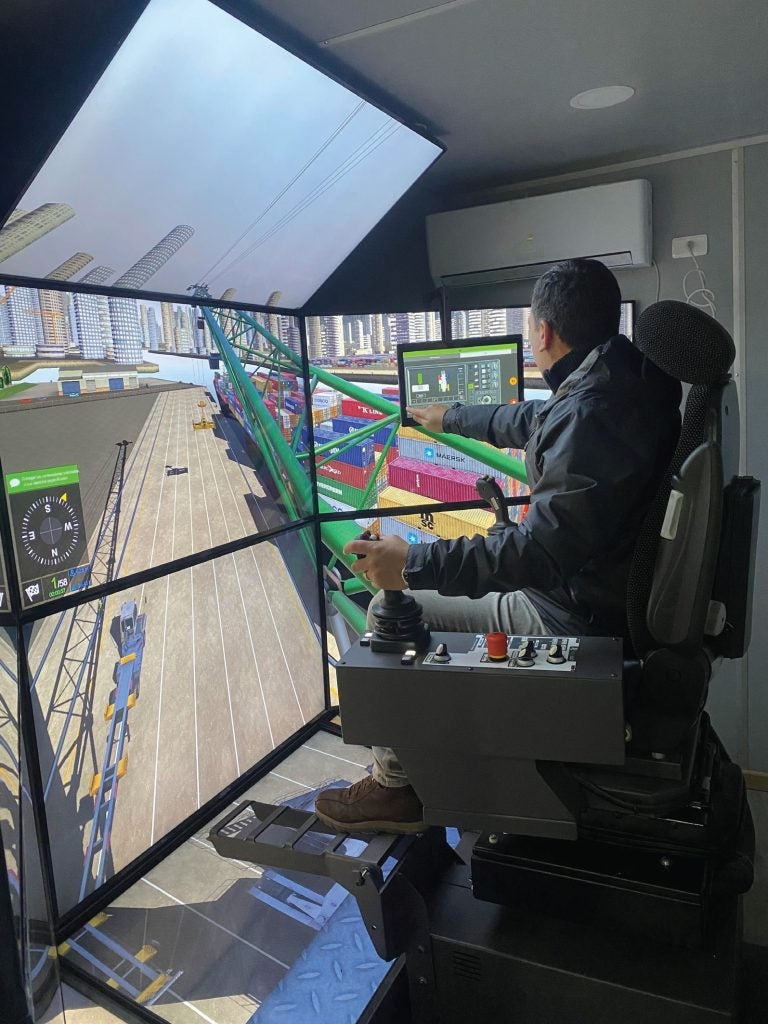
One component is the hardware. It can range from a laptop with a gaming joystick, via VR goggles worn by the students to ‘surround’ themselves with the virtual reality world of the crane, through to multi-screen setups in a ground-based reproduction of a crane cabin complete with exact replicas of the levers that he or she will be pulling.
“We have a wide variety of types,” says Alizadeh. “They go from desktop, mobile, VR-based types of simulators, to simulators that replicate industrial controls with screens and motion and haptic feedback.”
Haptic meaning that the ‘feel’ of the controls, and even the vibration and movement of the chair or cabin, is exactly as in the real thing. “These are very, very immersive replicas and integration of industrial controls. So that’s the hardware or physical component of the workforce training system.”
The software comes next – the digital programme that controls what you see on your screens or VR goggles. It can be generic, such as a bog-standard image of a bog-standard overhead gantry crane in bog-standard surroundings; or it can be customised. It can reproduce exactly the customer’s own crane, its performance characteristics, the layout of the factory it sits in, the nature of the loads and more.
Together, these form part of the simulator. “Then there needs to be a course, a curriculum for people to follow,” says Alizadeh. “So we built curriculum products such as our Intellia overhead crane curriculum. It takes people from novice to expert level through a defined set of exercises with different type of challenges, with a growing level of challenge and an increasing proficiency needed in order to build the skill set that is not just leading to productivity, but also to safety of operation. At the end, our customers are after operational excellence, which encompasses both safety and productivity.”
There is one more component to come. “The last component of the Intellia Workforce Training System is the tools that we built for instructors: they are training management tools. Because when you think about it, at the end you are creating a training system with human instructors as well as a digital course. You might have one instructor with ten students or 20 students at different stations. You would need an efficient way for the instructor to be able to serve multiple students at the same time,” says Alizadeh.
“So this expands the operation from monitoring how they are progressing, through live recording and management of those students. You are able to challenge them as they are doing their actual operation by injecting malfunctions into their system and seeing how they behave.”
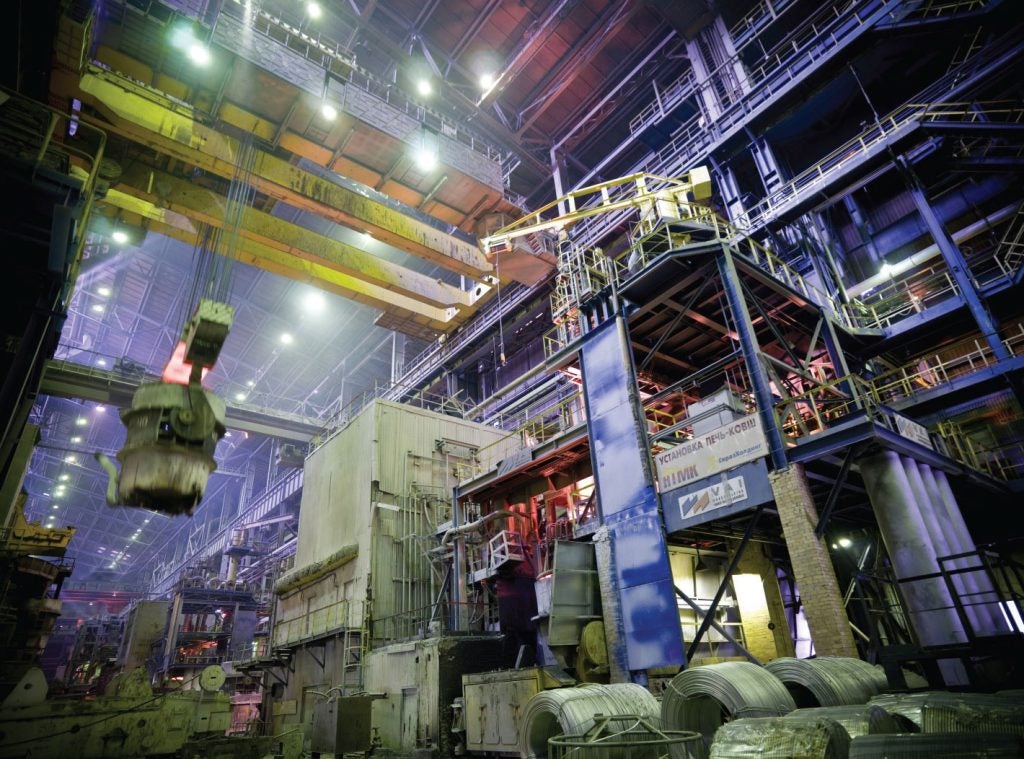
Some clients might use their overhead crane to occasionally move a steel beam. But a client operating a steel foundry, where crane operators handle multi-tonne containers of molten metal and pour them into moulds will want – and need – much more than that. For such clients, familiarity with the exact working environment is a must. “We can go into full immersive environments, and we can replicate a facility down to their exact process if they require that,” says CM Labs’s Jeremy Patterson.
Immersive and realistic
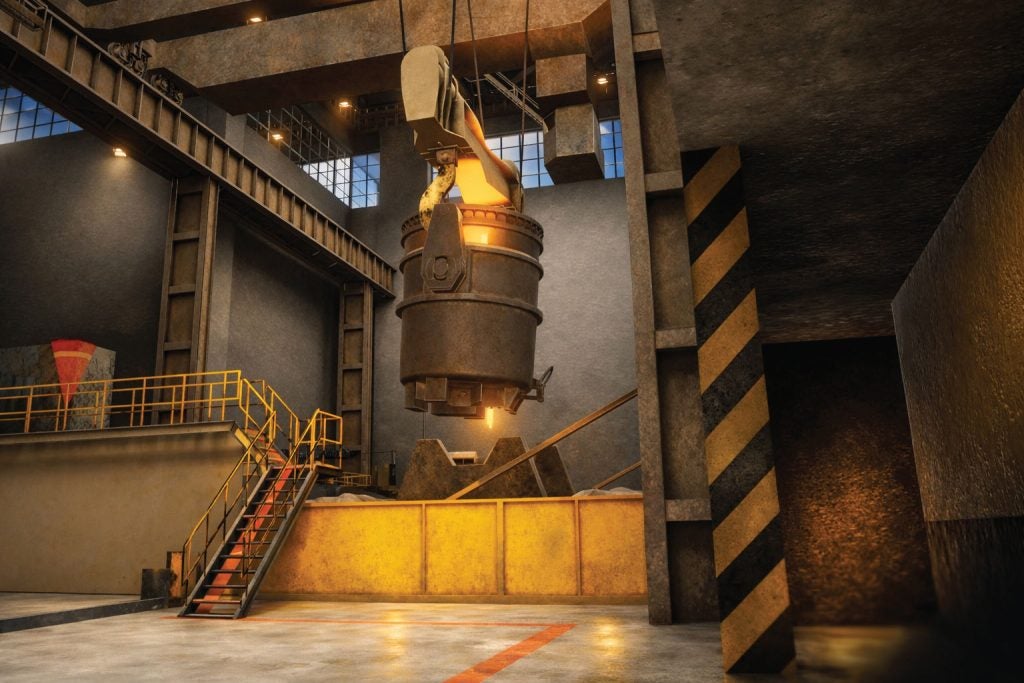
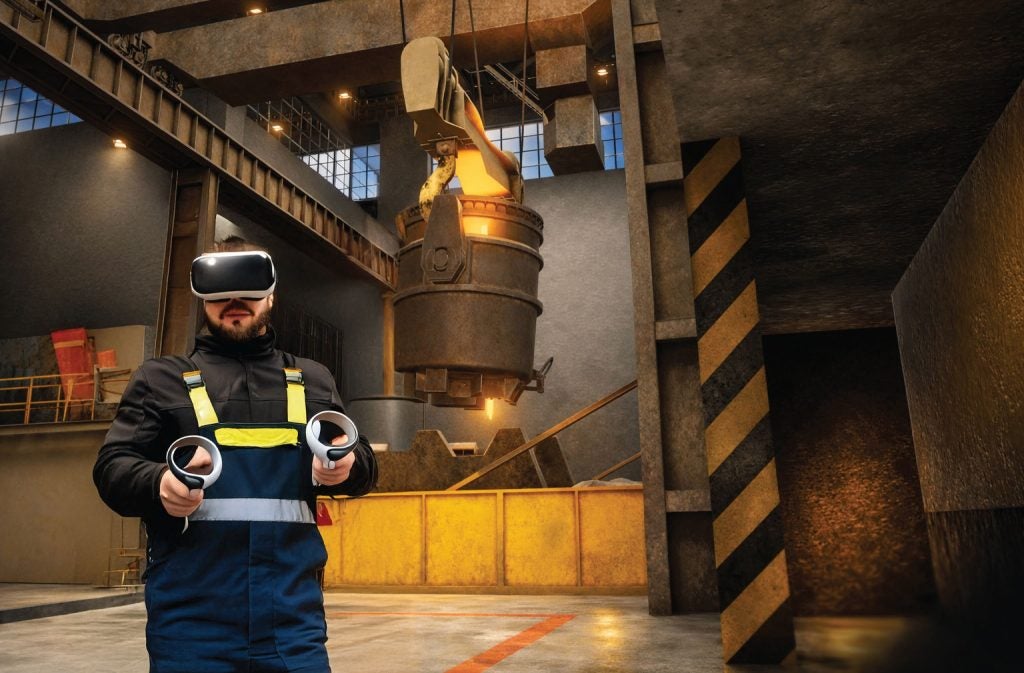
Virtual Rangers, based in Luxembourg, is another company specialising in immersive and realistic simulation training. In their simulation for Luxembourgian steel production company ArcelorMittal, the learner uses an overhead crane remote control to manoeuvre 220t hooks and lift steel ladles; he or she must follow a precise procedure that complies with the safety rules specific to the company’s industrial sites. In the event of errors, everything is recorded in the application and sent to a platform where all the trainees’ results are collated.
This application is designed to be driven by a human trainer who assesses the trainees’ bridge-handling skills. The trainer sees a different display from the trainee, and can see in real-time the mistakes made by the user.
“The training simulator we made for ArcelorMittal was very successful,” says CEO Matthieu Bracchetti. “Now we are developing another complete new range of crane simulator, with new scenarios and new cranes.
“We create simple day-to-day scenarios for the trainee, but then we can add in other scenarios where incidents happen – emergencies, people walking underneath the load, things like that – and we monitor the reaction of the students and everything that happens during the scenario.
Have they got good reflexes? Do they follow the rules?” So is the monitoring done automatically by the software or is there an instructor standing by the student to record how he performs? “That question is important,” Bracchetti says. “Everything is automatically recorded, all the mistakes that are made. There is AI inside the software analysing all the behaviour of the student; but we always like to have an instructor beside the student who has the final decision.
“So he might say, ‘Yes, you failed to see that obstacle, but I was talking to you at the time and distracting you, so let us take that into consideration.’ We always give the primary power to the instructor, to validate or cancel the simulation model. The same exercise can be repeated several times. If the student gets it wrong the first time, exactly the same incident can be replayed until he knows how to avoid this kind of problem.
It is tricky to reproduce the reality of what will actually happen with this kind of simulator, from the physical behaviour of the crane, the sway of the load, to how much the crane accelerates when the control button is pushed.
The surroundings also need to be modelled accurately, explains Bracchetti. “If the client is a steel foundry wanting to train its operators we will want to model how high the loads are lifted, whether the furnaces are on the right-hand side of the factory or the left, how far it is to the place where the metal is poured into the moulds, and so on.
“So the first thing we do when we receive a commission is to visit the client’s factory and make a high-resolution 3D scan at high texture. That will be our reference when we make our digital model. But we also record all the actions and instructions of the people using the crane.
We ask them questions, we follow them through the day, they explain all the detailed knowledge that they have acquired through experience. Our part, the magic that we do, is to convert the scan, add in the knowledge of these experienced people and mix it also with the crane’s performance date and with the engineer who actually works on that crane. All of those go to make your simulator.
This method works in many other sectors too, such as the medical sector training surgeons for operation. “Whatever the application, when we are asked to make a simulator our first question is always, ‘Where is the expert, the person who does these things all day every day in real life?’” continues Bracchetti.
“We can supply very simple hardware, modelling a standardised generic type of crane displayed on a pair of virtual reality goggles with a pendant or bellybox controller and a tablet or laptop to pilot your session. That way is very affordable, only a few hundred euros, so even a small company with only one crane can afford it.
“But our niche market is for tailor-made applications, because we know that every company has its own rules. We can recreate their control cabin and levers exactly; and we can exactly model their plant setup and crane.
At a certain point you have the golden rules that are the same for everyone, but every company also has its own protocols and rules and procedures, and we can programme those in as well. We like to go deeper into the details that the customer wants. We personalise it so they can train even more efficiently.”
Preparing for the worst
Another advantage of simulator training is that you can practice scenarios that you hope will never happen. “We can simulate accidents that you would not dare to try out in real life – the crane hitting an obstacle, or the load swinging dangerously close to a wall. We can recreate accidents that have happened in the past. We can create scenarios that train people to face the worst situation, so that if they ever do have to face it in reality they will have the reflexes to know what to do,” Bracchetti explains.
And a simulator is exactly that – a simulator. It may be amazingly realistic, but it is not the real thing, and training on a simulator is not the same as training on a real crane. “We always say that no matter how close we can get to it, we can never replace the real-life scenario. Our job is not to replace an instructor; nor is it to replace a real crane. It is a step that you take before you reach the real-life practice.
“It is good for you, the trainee, because you spend much more time on it, and become really familiar with it; it is good for the employer because it is reproducible – he knows you will have had exactly the same training, to exactly the same standard as all the other students.
And because it is economical – you are not taking his real, working crane out of commission while you do that practice. It is good for safety, because you will have faced emergencies; but even with all that, it is still not a real crane.”
One factor that is missing is fear: if you hit a wall on a simulator, you just press the ‘repeat’ button and try again. If you hit a wall with a real crane, you, the factory and everyone else can be in very real trouble. That is why no student should go straight form a simulator to being let loose alone on a real crane. “After success on a simulator, every trainee should have a supervised period on a real crane before handling it on his own,” says Bracchetti.
And, he says, there is one other thing that simulators can never teach you. “When we talk about training, we can train very efficiently for hard skills. But soft skills are another issue.” No crane operator works alone; he is part of a team. There are riggers, fitters, production managers, all kinds of people who do things to the loads that are lifted and moved and who are part of the whole operation. The crane operator must interact with these people. They must communicate, in sensible, meaningful and easily understood ways.
The operator must know what those others are about to do, where they will go, what they will need from the operator and what the operator will need from him. “These are the so-called ‘soft skills’,” says Bracchetti. “Hard skills – knowing which levers will move the crane in which directions and how fast – these are easy to teach. Soft skills – everyone instinctively knowing how the rest of the team will react – are much harder.” It is the difference between 11 brilliant football players who have never played together, and the same 11 playing as a team: it is that difference that wins championships. Training in simulators has a real and growing place.
But there is something about human interactions that remain in their essence human. The human touch cannot be removed entirely, either from work or from training.
Simulation trains experienced operators too
Steffen Banglow is a consultant specialising in simulation and has completed hundreds of projects and customer training sessions. He has worked particularly with Siemens on their Tecnomatix Plant Simulation software – in fact he has written the handbook for it – and leads workshops and conferences on the subject.
“It is a software tool can be used to make for crane training simulators,” he says; and such simulators can be as valuable to experienced operators as to novice trainees. “In modern factories, workpieces weighing several tons must be moved with precision. That requires not only sophisticated crane control but also seamless coordination between human operators and machinery. You might have a tandem lift using two or more cranes that must work seamlessly together. Using simulators to practice the lift in advance can help to plan and optimise such complex lifts.”
In normal production also simulators have a role. “Simulating the cranes in conjunction with human operators plays a crucial role in optimising workflow efficiency,” he says. “The challenge lies in synchronising crane operations with workers’ tasks in real time. You can integrate a remote control system into the crane simulation model, and so establish a direct interface between the worker and the machine. This allows tracking of how the crane is summoned to its operational position, loaded and transported to the desired location. The worker can precisely position the load using the remote control and then release the crane for the next task. You can model a highly accurate simulation of material flow within your production hall, so you can identify inefficiencies and prevent delays. Given that heavy cranes are not only expensive to procure but also costly to operate, precise planning is essential to minimise idle times and maximise efficiency.”
And they can model future crane projects to help planning new factories or additions to existing ones. “A realistic simulation helps to identify bottlenecks. You can determine the optimal number of cranes in advance. You can model a production system that uses two 20t cranes, and compare it to one that uses a single 40t crane; and that can save you expensive over-investment. Engineers often tend to add extra cranes to avoid production delays, but this is frequently unnecessary. A single crane can cost several million dollars, and over dimensioning can severely impact the economic feasibility of an entire project. Simulation helps to accurately assess your real-life requirements and determine the ideal number of cranes to maintain efficiency without creating production bottlenecks.”
It can even help in determining building structures. “As well as the number of cranes, the load distribution on the crane runway is a fundamental factor. The structural impact of using two 40t cranes differs significantly from using a single 80t crane. The weights and pressure distributions are very different, and strengthening a building after you have installed a crane on it is very costly. Simulation allows different scenarios to be tested during the planning phase so you can avoid expensive structural modifications later.”


