

How a decade of changes in crane control shaped the development of Noswing’s NS100E
More than a decade ago, Noswing began developing a different approach to crane anti-sway. Instead of relying entirely on a mathematical model of how a suspended load should behave, the original NS100 measured the angle of the hoisting ropes and used that information as feedback for crane motion control.
The principle was straightforward: rather than only estimating sway, measure what the load is actually doing.
Since then, crane control has changed considerably. Variable frequency drives have become more capable, PLC-based automation has expanded, and model-based anti-sway functions have become increasingly accessible. Industrial communication has also moved forward, and crane manufacturers and system integrators increasingly expect components to fit naturally into an existing control architecture.
For Noswing, that raised an important question: if crane controls have become smarter, what should a rope-angle sensor look like today?
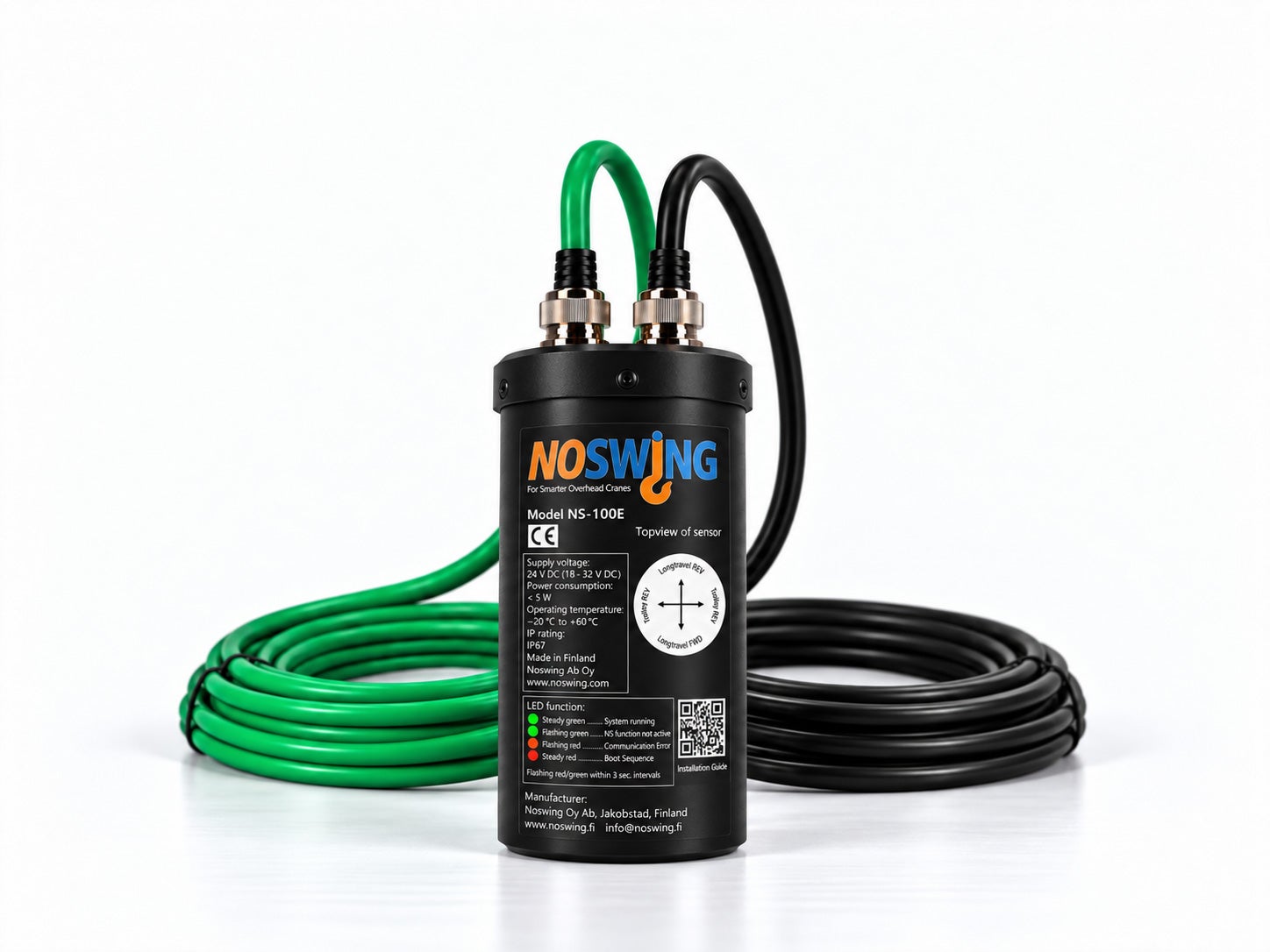
The answer became NS100E.
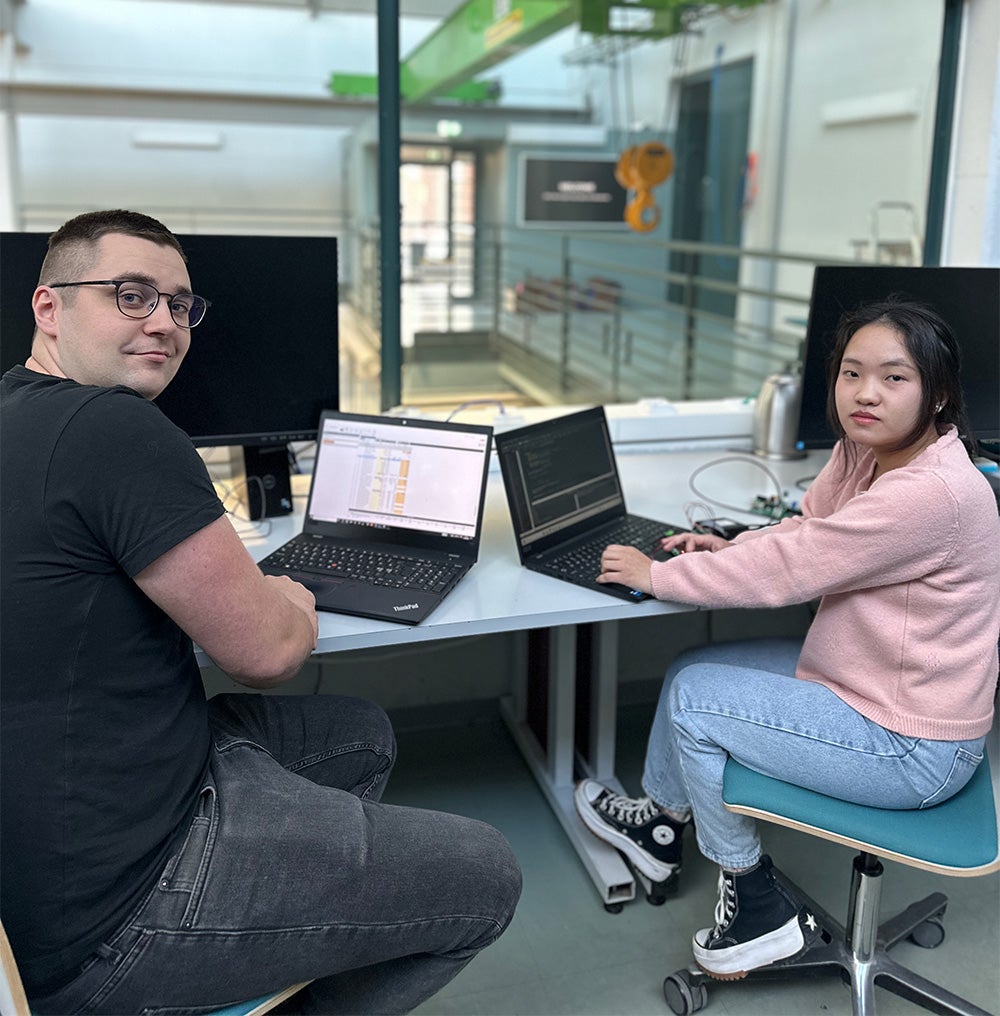
Ngoc Do, Embedded Systems Engineer at Noswing and lead engineer in the development of the new sensor, says the starting point was not to reinvent the principle behind the NS100, but to reconsider everything around it.
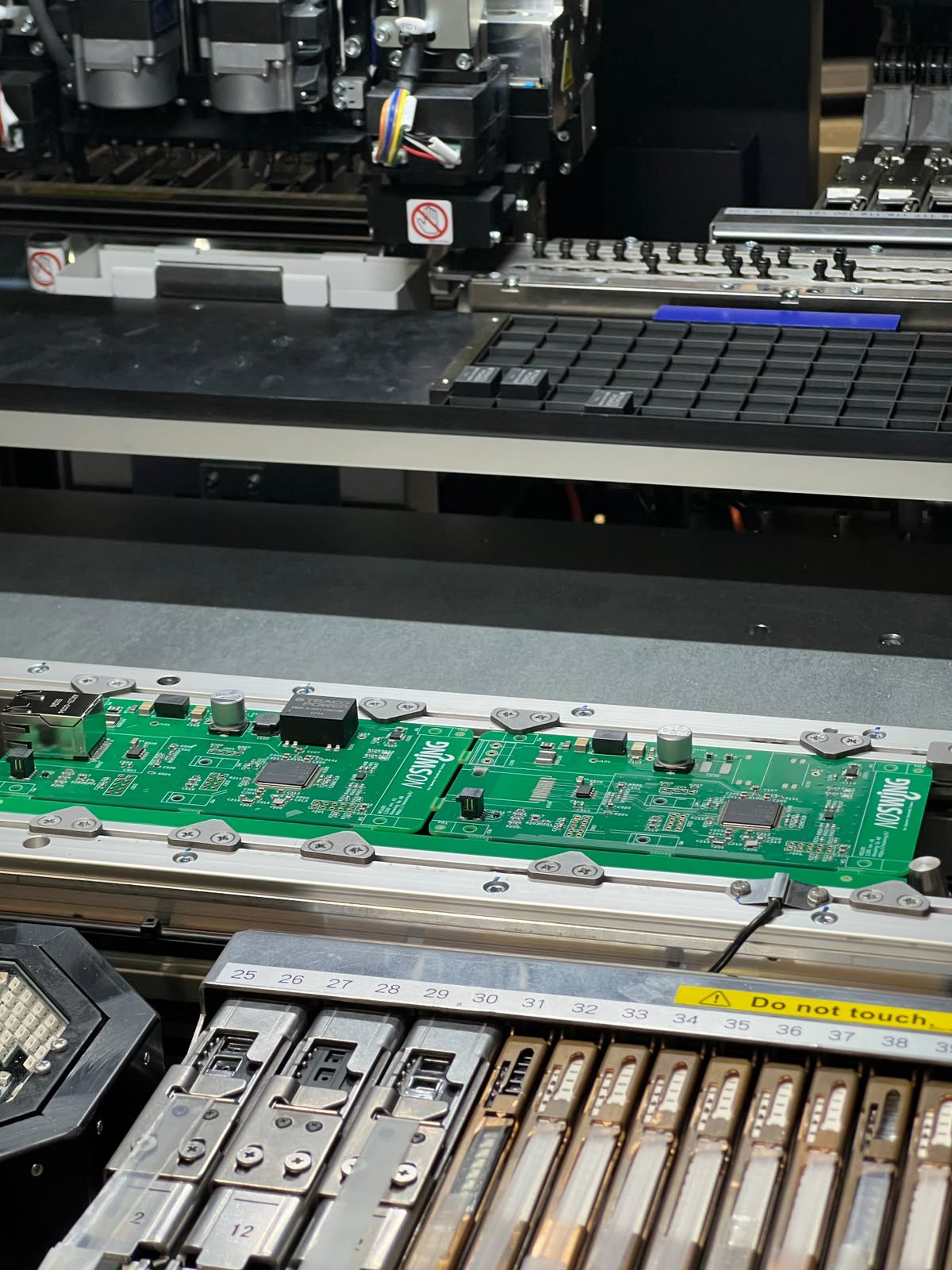
“The biggest change is the move from Modbus RTU over RS-485 to Modbus TCP over Ethernet,” she explains. “We have also replaced obsolete components with newer, higher-performance alternatives. The most notable upgrades are the new MCU and inclination sensor, and we have integrated a dedicated temperature sensor.”
Taken together, the changes have allowed the electronics to become more compact while increasing communication bandwidth and creating a platform that is easier to integrate and develop further.
The crane industry changed
When the original NS100 was developed, anti-sway was still a relatively specialised crane-control function. Today, the situation is different.
Modern drives can use mathematical models to estimate how a suspended load will react to acceleration and deceleration. PLCs are considerably more capable, automation is more common, and in many applications anti-sway can be implemented without measuring the rope angle at all.
That is not something Noswing sees as a negative development. For many cranes operating in predictable conditions, model-based anti-sway can provide exactly the performance required.
Instead, it changed the question Noswing had to answer.
The challenge was no longer simply how to reduce sway. It became a question of where measured feedback adds something that a mathematical model cannot provide, and how that measurement can be incorporated into the crane without creating unnecessary engineering work.
For Do, this was one of the clearest lessons from the original NS100.
“The NS100 taught me that measuring the rope angle accurately is only one part of the problem,” she says. “A sensor can work perfectly from a measurement point of view, but if installation, configuration, communication or troubleshooting is complicated, it creates additional work for the crane builder.”
That experience became one of the main starting points for NS100E.
Integration matters as much as measurement
The original NS100 communicated using Modbus RTU over an RS-485 connection. In practice, that can require an additional serial communication module in the PLC or drive, together with the correct RS-485 wiring, termination and communication parameters.
NS100E moves that communication to Modbus TCP/IP over Ethernet.
“For the crane builder, that makes the sensor easier to integrate,” Do explains. “The NS100E can connect to the existing Ethernet network and communicate directly with the PLC or drives, so there is no need for the additional serial communication hardware or for matching parameters such as baud rate, parity, termination, biasing and polarity during commissioning.”
In the NS100E architecture, the sensor acts as a Modbus TCP client and initiates communication with the relevant PLC or drive acting as a Modbus TCP server.
The important change is therefore not the measurement principle itself. NS100E still measures rope angle in two axes, giving the control system information about the actual movement of the suspended load.
What has changed is how that information reaches the crane controller and how easily it can become part of the surrounding automation system.
“For an integrator, the sensor can be connected directly to the crane’s Ethernet-based control network instead of requiring a dedicated RS-485 serial connection,” Do says. “It gives us higher communication bandwidth and fits much more naturally into modern PLC and drive systems where Ethernet is already used for control and diagnostics.”
NS100E is currently being developed around two particularly relevant crane-control environments: Siemens PLC-based systems and ABB ACS880 drive applications.
But easier communication is only one part of the development.
The broader aim is to reduce the engineering required between receiving a rope-angle measurement and actually using that information to control bridge and trolley movement. For PLC-based applications, that means combining the sensor with prepared crane-control functions rather than requiring the customer to build an entire anti-sway solution around the measurement themselves.
The intention is to make measured sway another usable control signal inside the crane architecture, rather than providing a measurement device that still requires substantial engineering before it becomes useful.
Measured or modelled?
That leads to perhaps the most important question surrounding a product such as NS100E. If modern drives and PLCs can already predict sway, why measure it?
There is no single answer for every crane.
For a predictable indoor crane with well-understood mechanical characteristics, relatively consistent loads and controlled operating conditions, model-based anti-sway may provide everything the application needs. In such a case, a separate rope-angle measurement may add relatively little.
The distinction becomes more important when the real behaviour of the load begins to differ from what the mathematical model expects.
A model calculates what should happen based on the information available to it. A sensor measures what is happening.
“Measured rope-angle feedback is most valuable when the crane dynamics are difficult to predict accurately,” Do says. “That can include outdoor cranes affected by wind, automated cranes where rope length, friction and mechanical tolerances vary, or operations where travelling and hoisting happen at the same time and the rope length is continuously changing.”
Unexpected disturbances are another example.
“It is also useful when something happens that the model cannot know about in advance, such as an impact,” she adds. “For cranes with more complex structural dynamics, direct measurement allows the controller to respond to the actual rope movement rather than relying only on the model.”
This becomes increasingly relevant as cranes move towards more automatic operation.
With a manually operated crane, the operator is effectively part of the feedback loop. An experienced operator sees the load moving and can change the crane movement accordingly.
As more of that movement becomes automated or semi-automated, information about what the suspended load is actually doing can instead be fed directly into the control system.
The point is not that measured anti-sway should replace model-based solutions everywhere. The two approaches address the same physical problem from different directions. Which approach makes sense depends on the crane and its operating environment.
When the real load does something unexpected
Outdoor cranes offer an intuitive example.
A mathematical model can calculate the sway caused by crane acceleration, but it cannot necessarily know that wind has started pushing a large suspended load sideways.
Noswing has encountered this in shipyard applications where large hull sections are transported by overhead cranes. A hull block can present a substantial surface area to the wind, and the resulting movement is not simply a consequence of what the crane drives commanded a moment earlier.
In that situation, measuring the actual suspension angle gives the controller information about a disturbance occurring in the real world, regardless of whether that disturbance exists in the mathematical model.
Do points to another, less obvious example.
“Imagine an EOT crane unloading a load from a storage rack,” she says. “While the load is moving, it can temporarily rub against something or snag and then suddenly release. That creates unexpected sway. Wind and aerodynamic effects can introduce further disturbances.”
Those are events that cannot be fully predicted from the commanded crane movement.
“A model-based controller cannot completely predict something like that,” she continues. “Measured motion feedback gives the controller the actual load behaviour. That creates a closed-loop system where the crane can respond to what has really happened and damp the resulting sway.”
The same reasoning can apply to unusually shaped loads, changing rigging arrangements or automated movements where the crane needs to arrive at a target position with little residual sway.
In simple terms, the value of measurement increases as predictability decreases.
From anti-sway to motion control
This development has also changed how Noswing thinks about the sensor itself.
NS100E is not intended to exist only as an isolated anti-sway component. Rope-angle measurement can become one input into a broader crane motion-control system.
If the controller knows how the bridge and trolley are moving while simultaneously receiving feedback about the actual movement of the suspended load, those signals can be used together.
That opens the door to functions extending beyond simply damping sway following an operator command.
One example is semi-automatic point-to-point movement. The operator can initiate a movement, while the crane control system manages the bridge and trolley towards a predefined position and simultaneously controls the movement of the suspended load.
In that kind of architecture, anti-sway becomes less of an isolated feature and more of an integrated part of how the crane moves.
That is also where the evolution from NS100 to NS100E becomes clearest.
The original sensor began with a relatively straightforward idea: measure the rope angle and use that measurement to control sway.
More than a decade later, that principle remains. What has changed is everything around it.
Drives are smarter. PLCs are more capable. Model-based anti-sway has improved. Automation expectations have increased, and industrial communication has moved forward.
NS100E is Noswing’s response to those changes. It is not intended to replace every existing approach to anti-sway. Instead, the development has focused on making actual load-motion feedback easier to integrate in the applications where knowing what the load is really doing can provide something prediction alone cannot.