

How do you address an ageing workforce and growing skills gap for port crane operators? One answer is to upskill your existing workers. And increasingly, this means using technology like crane simulators.
CM Labs supports port equipment training through simulation-based training systems designed to complement in-person instruction and live equipment experience. “Rather than replacing traditional training methods, simulation is used as a foundational and preparatory tool that strengthens the overall training process,” says Devon Van de Kletersteeg, ports and utilities product growth manager at CM Labs.
One indicator of a sector’s robust health is market consolidation. In December, CM Labs announced the acquisition of GlobalSim, a Utahbased developer of advanced training simulators.
“By combining GlobalSim’s market expertise with CM Labs technology, customers now have access to an enhanced suite of next-generation simulation-based training solutions that increase workforce readiness, improve safety and productivity and lower training costs,” he adds.
Demand shift
Kletersteeg believes that ports are prioritising workforce readiness, driven by rising container volumes and sustained pressure to improve productivity while maintaining safety and service reliability. “With more containers moving through terminals and fewer workers available, ports are looking for practical ways to improve safety and invest in their existing workforce,” he says.
Simulation allows operators to build core skills in a controlled and repeatable environment before transitioning to real equipment. “Trainees can practice operating equipment, making decisions and following safety procedures in a safe, simulated environment,” says Devon. Crucially, this includes handling equipment failures or unexpected situations that would be risky or disruptive to replicate in real life, giving operators valuable hands-on experience without the pressure of live operations.
“As digitalisation and automation continue to evolve, simulation provides a flexible platform that adapts to operational change,” he adds. “Whether supporting new equipment deployments, remote operations or workforce transitions, simulation enables ports to invest in people while maintaining operational stability.”
Deborah Schriegel-Bendik, training manager for Konecranes, agrees. “Working with simulators creates a safe environment allowing trainees to learn through trial and error, without pressure and without any risk to people or equipment,” she says. “This approach provides great flexibility, significant cost efficiencies and sustainability benefits.”
Simulator training also enables Konecranes to deliver training anytime and anywhere without tying up trainer resources. “In addition, minimising travel for in-person training lowers the carbon footprint,” she adds.
The highest priority for Liebherr-Rostock is safety. “First and foremost is safety,” says Christoph Reinhard, product manager, DiSC.
“Simulators allow emergency situations and extreme conditions to be practised without any risk to people or machines.”
Another key aspect is cost and resource efficiency. “While training on real cranes incurs high costs due to machine downtime, wear and tear and potential damage, operational equipment remains fully productive during simulator training,” adds Reinhard. “Studies show that training costs per operator can be reduced by up to 60%. In addition, repair costs and downtime are eliminated, which increases long-term profitability.”
Another advantage is standardisation and traceability. “Identical training scenarios enable consistent training and objective performance assessment. Participants’ progress is documented in detail, which supports targeted development from beginner to experienced crane operator.”
Lastly, simulator training contributes to sustainability. “By eliminating unnecessary machine movements, CO2 emissions are reduced and the service life of the equipment is preserved,” says Reinhard. “This method thus combines safety, efficiency and environmental responsibility.
Liebherr Container Cranes provides comprehensive operator and maintenance training for ship-to-shore (STS), rubber tyre gantry (RTG) and rail-mounted gantry (RMG) cranes. This includes crane operation, servicing and troubleshooting.
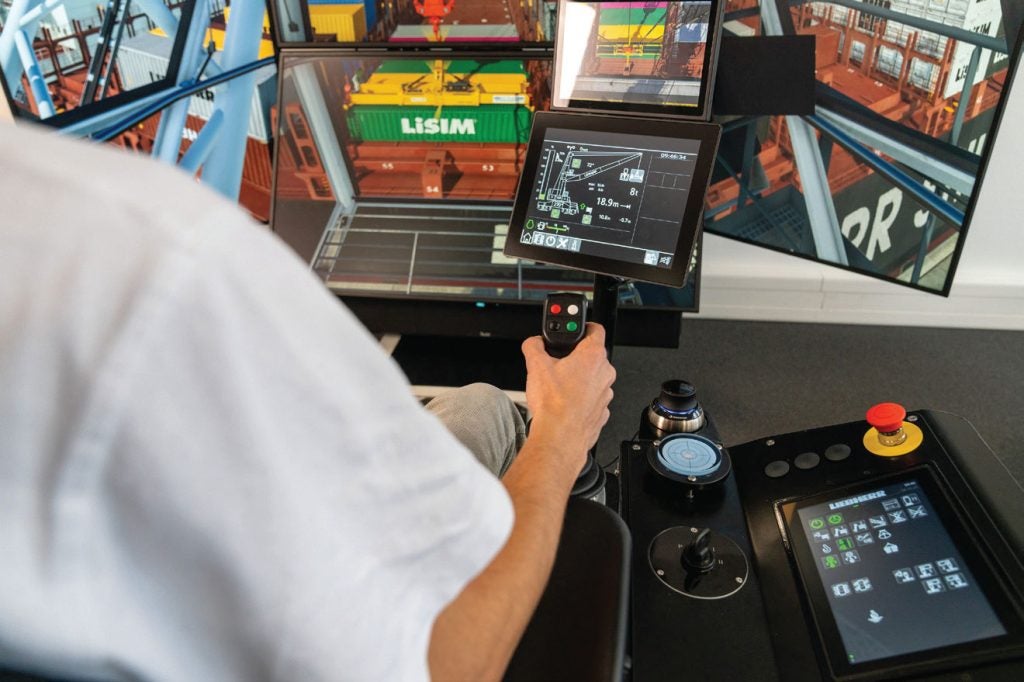
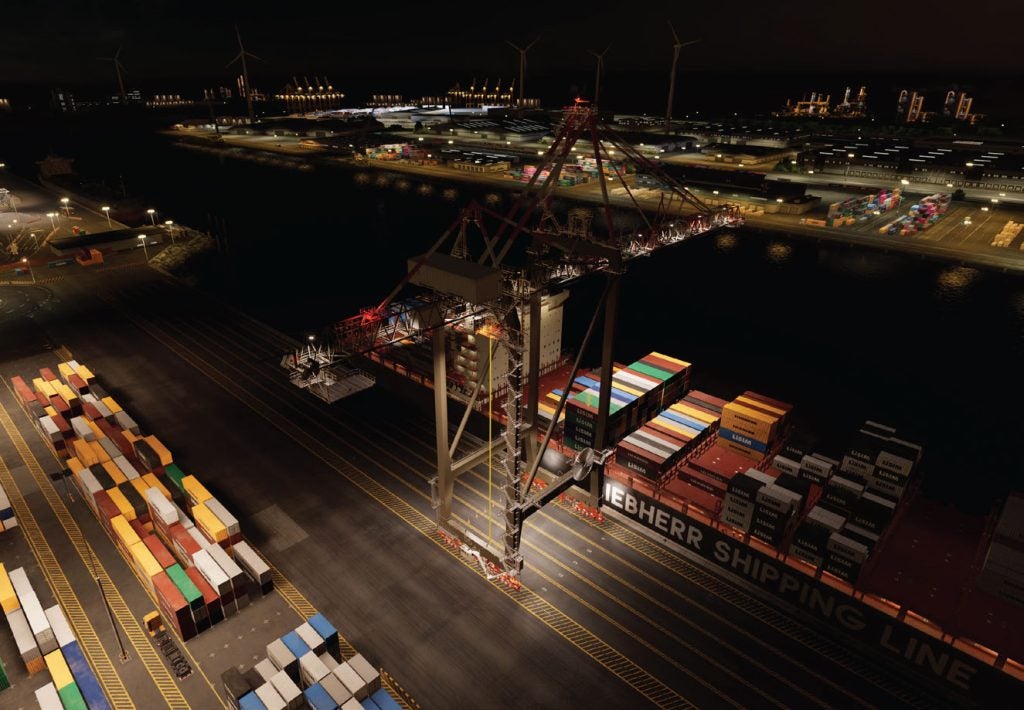
Liebherr recently introduced LiSIM ROS, a simulator for ship-to-shore cranes operated via remote operator stations. It is designed to provide a highly realistic virtual environment for mastering crane controls and advanced features.
Developed by the same engineers who design and build the cranes, the simulator accurately reproduces load sway, load response and moment of inertia, ensuring operators are fully prepared when transitioning to live operations.
“From a sustainability and cost perspective, simulator training produces almost no emissions and eliminates wear on operational equipment,” says Trevor O’Donoghue, head of marketing at Liebherr Container Cranes. “Training can be conducted at any time without taking cranes out of service, delivering a rapid return on investment and significantly lower operating costs compared with conventional training methods.”
Consistency is another key advantage. With LiSIM Driver Analysis, every movement is recorded and quantified, providing objective, measurable performance data. “This enables targeted development, evidence-based evaluation, and complete confidence in operator readiness,” says O’Donoghue.
“Scenarios can be repeated in exactly the same way, ensuring standardised training and fair assessment across all participants.”
Consistency is also a key metric for CM Labs, as training becomes independent of weather and equipment availability. “Simulation also generates objective performance data, allowing instructors to measure progress, identify skill gaps, and tailor training to individual needs,” says Kletersteeg. “This data-driven approach fosters transparency and continuous improvement across training cohorts.”
Career development
In addition, training is increasingly about offering career development opportunities for employees, rather than a one-off exercise of certification.
“LiSIM ROS supports the full operator lifecycle, from recruitment through to long-term retention,” adds O’Donoghue. “New operators can be identified and trained quickly, while experienced operators can refine their skills, practise specific scenarios, and complete structured refresher training. This approach builds confidence, improves control and supports operator well-being.”
Kletersteeg adds, “We are seeing growing interest in workforce training systems that support continuous development rather than one-time qualification.”
CM Labs’ Intelligent Workforce Training System is designed to help terminals manage training at scale, track performance objectively and align learning outcomes with operational goals. “This approach enables ports to develop talent more predictably while maintaining consistency across shifts, terminals and equipment types,” he adds.
Blended approach
However, across the board, providers agree that live training remains a vital element of learning.
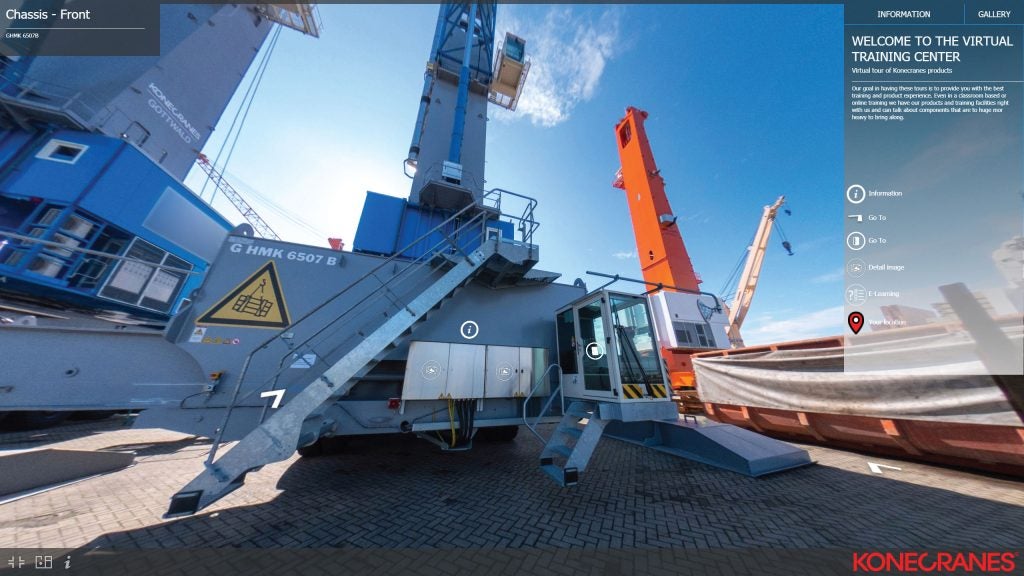
Konecranes offers a broad portfolio of training solutions for both customers and internal personnel. This portfolio covers training formats including in-person theoretical and practical training, simulator-based training, live webinars, online learning and VR. “These formats can be utilised individually or in combination, depending on the training objectives,” says Schriegel-Bendik.
“Effective learning solutions increasingly combine in-person, digital, and simulated elements. At the same time, in-person training continues to play a critical role and cannot be fully replaced.”
For more complex topics, Konecranes believes that in-person training remains essential, as it provides a more intensive learning environment, where trainees can focus entirely on the subject matter and receive high-quality, real-time feedback from trainers. “In-person training allows trainers to interpret nonverbal cues and respond immediately, fostering better interaction and engagement,” she adds.
“It also facilitates networking and informal exchanges, which are often critical for learning outcomes. Furthermore, for certain technical content, the haptic experience remains a key component of effective training. And one of the most evident advantages of in-person training is the absence of technical barriers or interruptions, ensuring a smooth and uninterrupted learning experience.”
Liebherr also offers a comprehensive training portfolio for crane operators and maintenance personnel, combining traditional classroom instruction with advanced simulator technologies and practical hands-on training. This covers both relevant divisions of its business: Liebherr- Rostock and Liebherr Container Cranes. Its maritime training centres (MTZs) combine traditional classroom training with modern technologies such as simulators and AR/VR to offer practical, safe and flexible training.
“This means we are ideally equipped to meet a wide range of learning needs – from the basics to complex scenarios,” says Iris Wahrig, head of the maritime training centre at Liebherr-Rostock.
Training is delivered worldwide through Liebherr MTZs and directly at customer sites. It is also integrated into the handover process for every new crane.
“Face-to-face training still has its place, especially for topics that require personal interaction, teamwork, and real-world experience. Simulators are superior for purely technical processes or high-risk scenarios, but face-to-face interaction remains indispensable for communication, leadership and complex discussions.”
This is echoed by CM Labs. “Simulation is expected to play a central role in port equipment training, but it’s not intended to fully replace hands-on experience,” says Kletersteeg. “The most effective training programmes will continue to combine simulation with in-person instruction and live equipment time.
“Blended learning is the most effective way to train port operators. It pairs foundational theory with simulation-based practice and supervised on-the-job experience, with each stage building on the last to boost retention, confidence and consistent performance before operators are fully qualified.”
Liebherr Container Cranes typically delivers face-to-face training that combines structured theoretical instruction with practical training on real equipment, systems, and components.
“Physical presence allows trainees to engage directly with machinery, ask detailed questions and experience real-world operating conditions,” says O’Donoghue. “Simulators play an increasingly central role in operator training and are highly effective for building foundational skills, practising complex or high-risk scenarios, and standardising training outcomes.
“However real equipment experience remains a key component of skill improvement. Advances in simulation will continue but a blended approach is likely to remain the optimal model for the foreseeable future.”
Different benefits
Therefore, if there is still a place for in-person training, what benefits does it bring? Liebherr-Rostock sees classroom-based training as offering direct interaction with trainers and other participants. This provides a better forum for more in-depth discussions about its products and complex systems.
“Classroom training enables direct interaction with trainers and participants and is particularly suitable for product training, system understanding and safety instruction,” says Iris. “Complex crane systems and operational concepts can be discussed in depth in a structured environment.”
Liebherr-Rostock’s professional operator training combines theory, simulator exercises and real machine practice to build deep understanding of control systems, assistance functions and efficient working processes. “This blended approach ensures safe, efficient and future-oriented training for all experience levels,” she adds.
Simulator training uses Liebherr’s LiSIM Pro, LiSIM Move and LiSIM ROS platforms. These simulators take centre stage for risk-free and practical practice before real machines are used.
“Simulators are particularly superior when safety, cost control, flexibility, and practical experience are paramount,” says Reinhard.
“Face-to-face training remains useful for discussions, soft skills and team dynamics – the future often lies in a combination of both.”
Market penetration
In Europe and North America, CM Labs sees simulators becoming a go-to training solution, helping operators sharpen skills such as crane handling and safety procedures, while providing the opportunity to upskill for higher-level roles. Demand is increasing in markets like Latin America due to extensive port modernisation programmes.
“Even as some port terminals adopt different levels of automation, we believe the role of operators will evolve,” says Kletersteeg.
“Simulation training is applicable across multiple terminal operating models. In manual terminals, it supports equipment operation training, while in automated and remote-operated terminals, it is used to develop system supervision and exception-handling skills.”
For Liebherr-Rostock, simulators have become established in port crane training because they combine safety, efficiency, practical relevance and cost advantages. “They are not only a supplement, but in many cases the preferred method for technical and safety critical training,” says Reinhard. “Face-to-face training remains important for soft skills and teamwork, but technical training is increasingly shifting to virtual environments.”
Recent advances in simulation realism have strengthened its impact for port operators. “High-fidelity crane physics, accurate machine behaviour, and immersive operational environments give operators and instructors accelerated skill development,” says Kletersteeg. “As a result, simulation is no longer viewed as experimental, but as a professional training tool that supports measurable outcomes.”
For Konecranes, simulators play an important role in today’s training landscape.
“They provide a safe and controlled training environment that protect both people and equipment,” says Schriegel-Bendik. “Especially simulator-based operator training offers significant advantages, including eliminating the risk of equipment damage and enabling operators to start real machine operation with greater confidence and higher level of knowledge, which in turn reduces the likelihood of incidents.”
However, it is limited in its application.
“Based on our experience, the primary focus of simulator training is currently on crane handling and operator skills,” she adds. “Maintenance training, however, is still mainly delivered through in-person training that includes hands-on practice on actual machines or specialised technical simulators designed to replicates crane systems.”
Could there be a future where simulation completely replaces in-person training?
“We believe that the future belongs to simulators,” says Reinhard. “They will take over the majority of technical and safety critical training. But 100% virtual training is still a good decade away and will probably never be able to replace all face-to-face formats.”
Liebherr-Rostock predicts that simulators will continue to take over a growing share of technical and safety-critical training. “They are highly effective for building basic skills, practising complex scenarios and standardising training outcomes,” adds Reinhard.
“However, real equipment experience will remain essential. For the foreseeable future, a blended training approach combining simulators and face-to-face instruction will remain the optimal model.”
Konecranes cannot envisage training without that human element. “Simulators in their various forms are already widely used, and this trend will continue to grow as the technology improves, so we think that simulations will continue to increase in importance,” says Schriegel-Bendik.
“Given the nature of our business and the importance of in-person sessions, we think that, in the future, the human element, the trainer, will remain a critical factor designing and delivering effective training concepts.
The success of virtual simulations or online training will still depend on the degree to which genuine, personalised feedback can be integrated into the learning experience.”
Positive outlook
The outlook for simulation-based training in port environments remains strong heading into 2026. “Overall, we expect the role of simulation in port training to continue expanding in 2026 as terminals seek solutions that deliver measurable results, support long-term workforce planning, and build operator confidence across a range of operating models,” says Kletersteeg.
“Looking ahead, simulation will function as the backbone of modern training programmes, supporting in-person instruction, enabling data driven development and helping ports build adaptable workforces ready to meet evolving operational demands.”
In 2026, Konecranes will launch a new external learning management system, the Konecranes Training Hub, designed to provide customers with a single point of access to its global training offering. “The platform will improve visibility of available trainings, simplify enrolment and administration and support a more structured and data-driven approach to customer learning,” says Schriegel-Bendik.
By improving access and consistency across online and blended training offerings, Konecranes expects that its training hub will increase customer engagement with its training portfolio and support broader adoption of digital and blended learning formats.
“As a result, we expect growing interest in our training services and a positive impact on training utilisation in 2026.”
Liebherr-Rostock is also very positive in its outlook. “With the introduction of our newly developed simulator, we are setting a milestone in crane operator training,” says Reinhard. “We expect high market acceptance, as the simulator offers decisive advantages: risk-free training, no strain on the machines and flexible scenarios for different operating conditions.
He believes it will improve the quality of training and increase customer satisfaction in the long term. “By combining state-of-the-art technology with practical exercises, we want to position ourselves as a pioneer in this segment and create a future-oriented solution for our customers.”
Liebherr-Rostock expects continued strong demand for both training programmes and simulator solutions in 2026. “Automation, remote operation and sustainability targets are increasing the need for structured, future-proof training concepts,” he adds. “Customers are placing greater emphasis on high-quality, standardised and scalable training solutions that support both new and experienced operators.”
His colleague O’Donoghue agrees. “As we move into 2026, we expect demand to remain strong for both our training programmes and our simulator solutions,” he says. “This is driven by ongoing automation, increasing use of remote operation and the continued focus on safety, sustainability and workforce development across the port sector.
“Customers are placing greater emphasis on structured, future-proof training solutions that support both new and experienced operators.”


