

While it is impossible to predict precisely what the future will hold, there are broad trends that will impact our industry in the coming months. Some will present challenges, while others will undoubtedly be opportunities.
As we move into 2026, geopolitical turbulence dominates the news headlines. But, of course, commerce also continues. And this means ongoing investment in cargo handling equipment. However, it remains a changeable market, particularly due to US tariffs.
In its financial report for Q3 2025, Konecranes noted that tariffs continued to cause uncertainty in customer decision-making, especially in North America.
“Konecranes is well positioned in the global landscape, but we remain affected by the tariffs,” says CEO Marko Tulokas. “We have been successful in managing their adverse impact through our own pricing actions and had a timing-related tailwind for the third quarter, but recently the situation has become more challenging.
“Moving forward, we expect the tariffs to cause some headwinds but not place us in a generally weaker position against our competition.”
Konecranes’ full year financial results are expected in February.
Dynamic market
For crane manufacturer Kuenz, a dynamic market requires manufacturers to become even more flexible than before.
“The key industry trend for 2026 is flexibility across all dimensions, driven by rapidly changing market, technological and regulatory conditions,” says CEO David Moosbrugger.
He envisages flexibility manifesting in several ways, starting with automation strategies. “Customer requirements regarding automation continue to diverge,” he explains.
“Some customers remain focused on highly automated crane systems that operate fully autonomously, with human intervention limited to remote control desks in exceptional cases.
“Others, however, are reassessing this approach and increasingly favour solutions that combine manual operation with remote control capabilities, prioritising operational flexibility and human oversight.”
The other aspect is regional flexibility, both in the US and European markets. In the US, he sees flexibility in manufacturing and supply chain strategies as essential. “Changing boundary conditions such as subsidies, tariffs and local content requirements can significantly influence where and how crane systems should be manufactured,” he adds.
“Flexibility is also critical in Europe, where economic conditions vary significantly across countries. While some markets remain strong and investment ready, others, such as Germany, are currently facing slower economic momentum, requiring suppliers to adapt their market approach.”
Here, strength in depth is vital. Kuenz offers a broad portfolio, ranging from manually operated RTG cranes to fully automated RMGs. “This flexibility extends to the crane configurations themselves,” adds Moosbrugger. “Kuenz cranes are based on a modular design approach, enabling rapid customisation and allowing Kuenz to respond quickly and effectively to specific customer requirements.”
Ongoing trends
For other OEMs, many of the trends impacting 2026 are carried over from the previous year.
“I see no clearly new trends on the horizon for 2026 but expect there will be a continued drive and strive for further improved productivity and predictability,” says Lars Meurling, vice president, EMEA and marketing for crane spreader manufacturer, Bromma. “This is driven by several things, perhaps with the most important factor being the ongoing addition of higher capacity vessels to the global fleet.
Larger vessels implies more capital bound in the asset that is effective the less time spent in ports.”
Hyster agrees. “Our customers in ports and terminals tell us that many of the existing challenges and trends affecting them will continue in 2026,” says Ricky Hiriani, global commercial product leader for Hyster. “There is still a demand for high uptime, productivity and ease of repair. This is where durable diesel trucks with long service life, strong suspension, hard-wearing drivetrains and effective cooling systems that can perform reliably in diverse environments continue to play a major role for ports and terminals.”
For Elme Spreader AB, these ongoing trends are around sustainability and geopolitics. “The electrification continues,” says Jens Petersson, head of sales and marketing. “However, there are trade obstacles on the political level.”
The company believes it already has a range of products to help customers address the main industry trends – and has more in the pipeline. “The Elme in-house production philosophy helps the customers to meet new requirements,” adds Jens. “We will launch new products to help more segments and customers in the market.”
Electrification
Kalmar forecasts that electric equipment will move from 15% of the total market in 2023 to 41% of the market by 2028. Its customer satisfaction survey showed that 63% of respondents were planning to invest in low or zero emission equipment by 2028. Just over one tenth of orders placed with Kalmar in Q3 2025 were for fully electric equipment.
Hyster sees customer interest in emissions reduction remaining strong.
“Adoption globally varies by market based on regulations, infrastructure and day-today operating requirements,” says Hiriani.
“Electrification of container-handling equipment is still relatively new, but development is moving quickly, and several ports around the world are already trialling electric models to understand how they perform under demanding duty cycles.”
Heavy-duty equipment for port environments is steadily moving toward lower-emission solutions, with battery electric models gaining traction where charging infrastructure can support them.
Hyster is leveraging lithium-ion technology to create new opportunities for high-capacity electric equipment. Lithium-ion batteries can deliver strong power density and stable output, with a long service life that supports demanding operations. “They can also handle high energy demand without overheating, an advantage that helps extend electric power into heavier duty classes,” says Hiriani.
Hyster has already introduced factory integrated lithium-ion models in the 7,000– 18,000kg range. For instance, the Hyster J10-18XD series provides the performance and rugged reliability required by demanding environments, with a range of battery sizes to match duty cycle and charging requirements, configurable up to 280kWh. The 350-volt architecture provides a right-sized solution for ICE-like performance and energy efficiency.
Hyster is also now applying electric power to larger port equipment, including container handlers, reach stackers and terminal tractors, as operators explore lower-emission options for high-intensity environments.
However, diesel is going nowhere. “Diesel platforms will continue to evolve in parallel, offering lower emissions and better fuel efficiency in operations where electrification is not yet practical,” adds Hiriani.
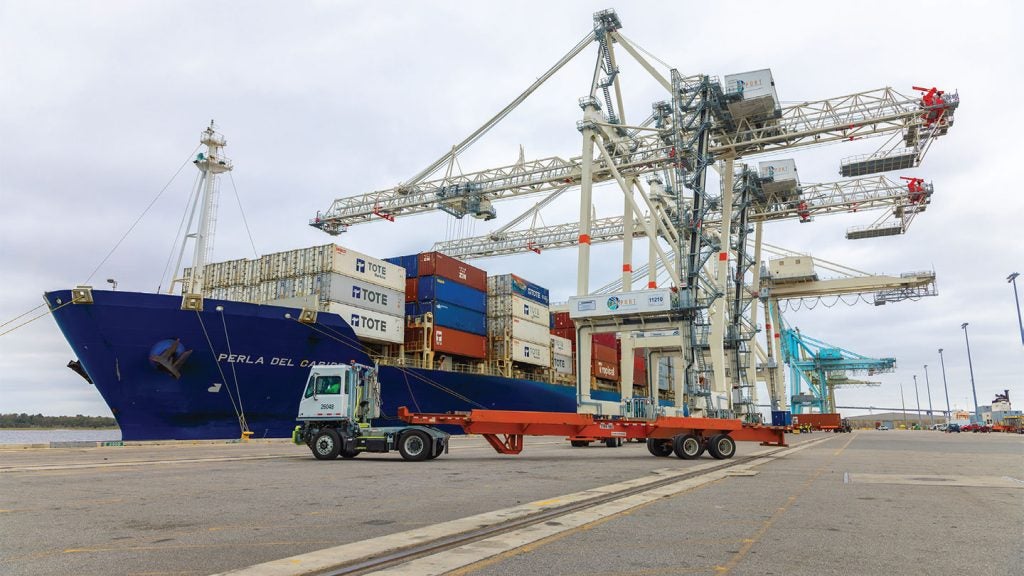
Recent evidence of the transition to electric equipment includes Jacksonville Port Authority (Jaxport) investing in two new STS container cranes. Some of the largest 50-gauge cranes on the market, they enable Jaxport’s Blount Island marine terminal to serve wider vessels.
The Liebherr cranes feature regenerative power systems, which consume energy during container lifts and capture electricity when lowering them – enhancing energy efficiency and reducing emissions.
Florida’s largest container port, Jaxport required STS cranes with the ability to reach up to 19 containers across a ship’s deck. They can move an average of 33 containers per hour and a lift capacity of up to 65 long tonnes, with heavy-lift capability of up to 75 long tonnes for oversized, non-containerised cargo.
A third new 50-gauge crane arrived at Jaxport in early December and is currently being commissioned at the port’s Talleyrand Marine Terminal.
The three cranes were purchased as part of a multi-year, $93m initiative to modernise Jaxport’s crane fleet, including $53m in state funding over the past two years for crane purchases and upgrades.
“As cargo volumes grow, it’s essential that we continue investing in the equipment needed to serve our customers efficiently,” said Jaxport CEO Eric Green.
Digitalisation
Another ongoing trend is digitalisation. Bromma sees this as helping to further minimise equipment downtime and speed up container handling.
Its SMS fleet monitoring tool is designed to reduce spreader downtime. It monitors the health of each spreader, providing real-time insights to the operator. This helps them make informed decisions about what spreaders to use and when to take them out for maintenance. SMS also provides detailed information on any kind of issue including recommendations for resolving them.
In addition, it offers Hawkeye, a spreader mounted camera technology platform. It uses algorithms and AI read the container ID, detect dangerous lifting situations such as two 20ft containers being addressed as one 40ft container, and has applications for documenting damaged container.
“The Bromma Hawkeye platform is an example of functional improvements that will enable productivity improvements,” says Meurling. “Perhaps the most obvious productivity enabler is to simply transfer the video signal from the spreader to the crane driver for the driver to get a closeup of the container and what is going on in its vicinity.”
Hyster also sees digitalisation becoming increasingly central, with telematics and predictive maintenance tools helping operators extend equipment life and run fleets more efficiently.
“More fleets are adopting telematics to improve productivity, manage energy or fuel use and plan maintenance based on real operating conditions,” says Hiriani.
Beyond day-to-day monitoring, he sees this data as increasingly informing broader operational decisions such as optimising routes, identifying bottlenecks and understanding how factors like climate and duty cycles influence equipment performance.
“This shift toward data-driven planning is helping fleets operate more efficiently and extend equipment life,” he adds.
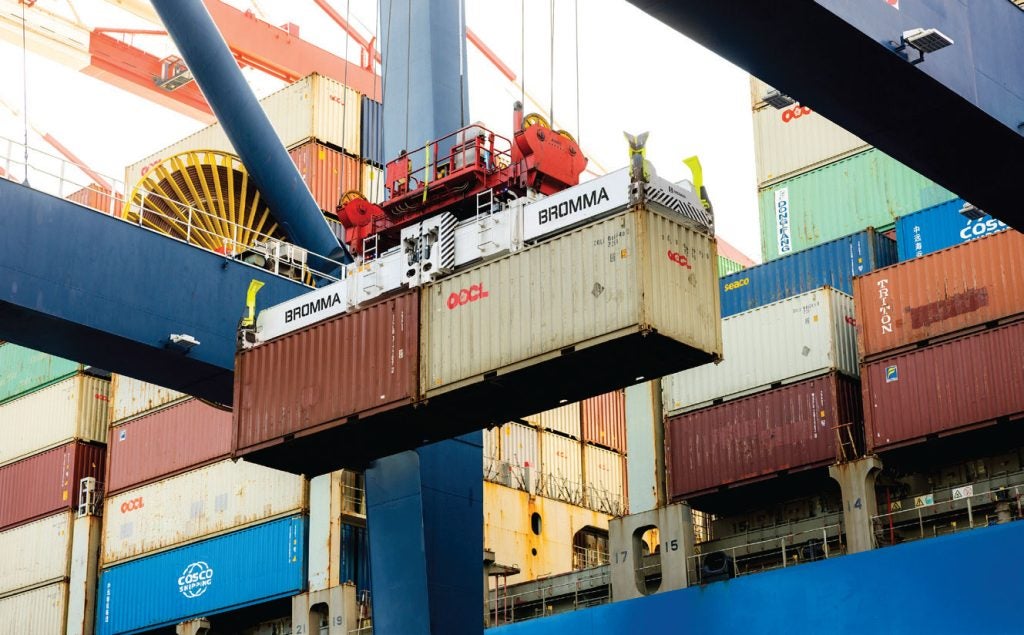
Helping drivers work with greater precision and visibility is also important for achieving efficiency gains. Hyster operator-assist technologies and monitoring features and telematics, like Hyster Tracker, can be used to manage fuel or energy usage, reduce idle time and plan maintenance more effectively, helping fleets operate more efficiently.
Container statistics
The latest data on container volumes came as a pleasant surprise and there is hope that this trend continues into 2026.
On a day-for-day basis, November 2025 was a record month, according to Container Trade Statistics (CTS). That month recorded an average of 553,000 TEUs lifted per day, surpassing August’s daily average of 543,000 TEUs. However, August remains the month with the best overall performance by virtue of having one more day than November.
This surprised analysts because, traditionally, November sees a slowdown – numbers have declined in this month for the past four consecutive years. “This reinforces the reality that 2025 is far from a ‘normal’ year for the container shipping industry,” CTS says.
Global container volumes in November 2025 reached 16.6 million TEUs, ranking it as the third-highest month in what has stood out as a strong year. Volumes were up 7% compared with November 2024, 12% versus 2023 and 22% on 2022 levels.
More good news followed, as the Global Price Index halted its four-month decline in November, rising by 2 points to 75. However, the index remains a full 20% lower than November 2024. This underlines how pricing pressure continues to impact shipping, despite sustained volume strength.
Breaking the market down into regions, North America saw a 1.8% decline for the year to date – equivalent to around 500,000 TEUs.
CTS noted that this was a smaller decline than some analysts had predicted due to tariffs. At the other end of the spectrum, sub-Saharan Africa recorded the highest percentile growth at 17.1%. This was driven primarily by increased cargo flows from North America and Asia, both of which were up by more than 25%.
Europe’s import figures also continued to climb, rising 7.4% year to date. CTS noted that, unlike previous years, this growth is spread relatively evenly across most exporting regions, with the exception of Australasia and Oceania. In absolute TEU terms, Asia remains Europe’s dominant supplier, maintaining a substantial import–export imbalance. In November, what CTS calls Europe–Far East trade stood at 3.4 TEUs imported per one TEU exported for Europe.
When it comes to export growth, Asia was up more than 6% in the year-to-date figures, despite a decline of 3% in exports to North America. However, leading the export league table was the Indian subcontinent and Middle East, with a 9.1% increase. In particular, exports from this region to sub-Saharan Africa have surged by over 16% year to date, further demonstrating the growing importance of these emerging trade lanes.
Overall, CTS believes that a 5% year-on-year increase for the full year “now appears firmly within reach, despite the numerous external pressures faced by the market throughout 2025.” But will this continue into 2026?
Outlook
Overall, Kuenz is prepared for a very good year.
“The outlook for 2026 is very promising, with manufacturing capacity already fully booked,” says Moosbrugger. “Kuenz has also begun securing production slots for 2027.
“In addition, Kuenz will introduce new products in 2026, positioning the company as a supplier capable of offering the full range of crane systems for container stacking in ports, as well as complete cargo handling solutions for intermodal terminals.”
Kalmar is forecasting global growth of circa 4% per annum for the entire heavy material handling market. This encompasses crane spreaders, empty container handlers and reach stackers, forklift trucks with a capacity greater than 5t and terminal tractors. Kalmar estimates the global market will grow from €13.4bn in 2023 to €16.5bn by 2028.
Bromma could not comment on its own business performance. However, Meurling thinks we might see a downturn. “On a general note, I would not be surprised if there is a certain slowdown as a reaction after a couple of years of high investments, driven by the ‘post-Covid catch-up’ and effects from the geopolitical situation in the world, the rerouting of vessels around Cape Horn not the least,” he says.
Conversely, Elme Spreader is forecasting an increase in sales for 2026. “Elme Spreader expects to grow during 2026,” says Jens. “We have a strong order book and together with our new products we have a good feeling for the upcoming year.”
Hyster sees success in remaining responsive. “Our commitment is to help customers identify the right solution for the specific application,” says Hiriani. “This is the foundation of meeting productivity targets while also maintaining a low total cost of ownership (TCO).”
Across all equipment classes, Hyster believes that low cost of operation and ownership will remain a key buying consideration. “Durability, reliability and strong after-service support will continue to guide investment decisions as operators plan their transition toward greener, more datadriven operations.”
Market forecasts
Industry analysts Skyquest Technology Group estimate that the global cargo handling equipment market size was circa $31.6bn last year. It forecasts significant growth, expecting market size to reach $47.7bn by 2033. This represents a CAGR of 5.3% from this year until then.
“The market for cargo handling devices has experienced a massive expansion in recent years, driven by the growing need for effective handling of goods across many industries,” it says. “An increasing number of countries are engaging in international trade, which has led to a need for sophisticated and dependable technology to facilitate logistics operations. Important players in the market are always coming up with new ideas to provide technologically advanced solutions that boost output and cut costs.”


