

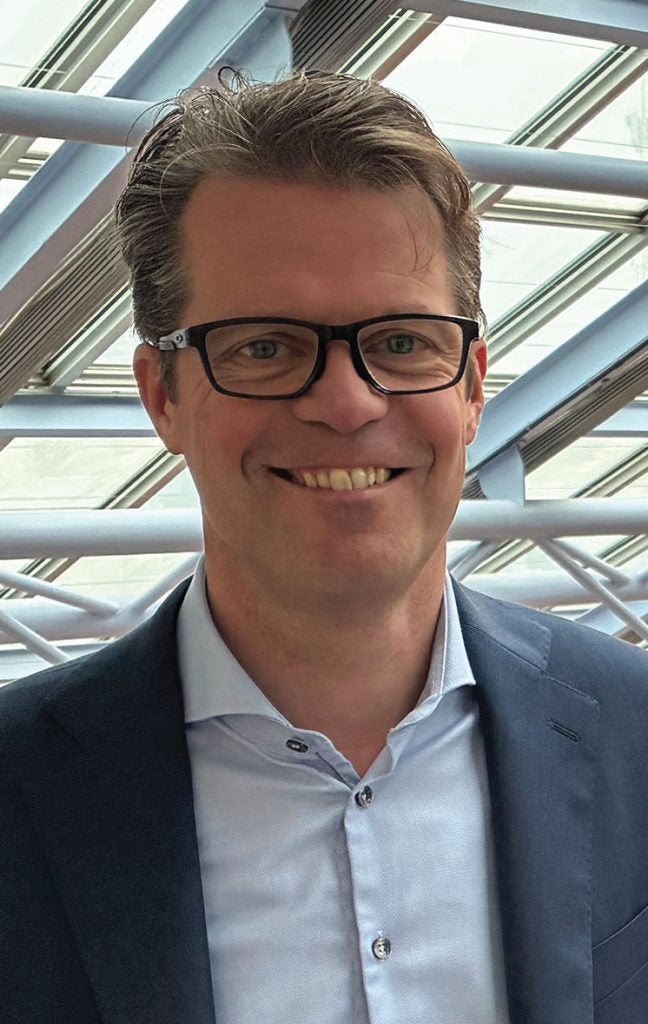
Arjan Meijer has arguably one of the most exciting jobs in our industry right now – the opportunity to build an entirely new market for Huisman. “I am very excited to be building something from the ground up,” he says.
He is relishing the responsibility of building the brand in the ports market. “I need to deliver results, but as a family business, they are also giving me the freedom to do things my own way.”
The Dutch company is known globally in the offshore sector, with 2026 marking 45 years since its first floating crane, launched in 1981. Along with deepwater pipe laying systems and drilling packages, Huisman’s offshore expertise includes decades of crane design and manufacturing. In fact, it still holds the record for designing and manufacturing the world’s tub cranes, developing the 10,000t capacity tubmounted cranes for Heerema’s Sleipnir semisubmersible vessel.
This project underlined the benefits of in-house engineering and manufacturing. Huisman designed and produced its own bearings to replace the bogies and wheels traditionally used for the slew system.
Launching a ports equipment division was thus a natural step, but also a bold move into what is already a competitive marketplace.
Enter Meijer, who joined Huisman in 2025 to help grow its ports equipment business. “I am really enjoying being back in a crane sales role,” he says. “Promoting a new Dutch crane OEM is a fantastic opportunity for me.
“The company has all the tools in place to be successful in this market. It has decades of engineering experience, in-house design and manufacturing and an established global service network.”
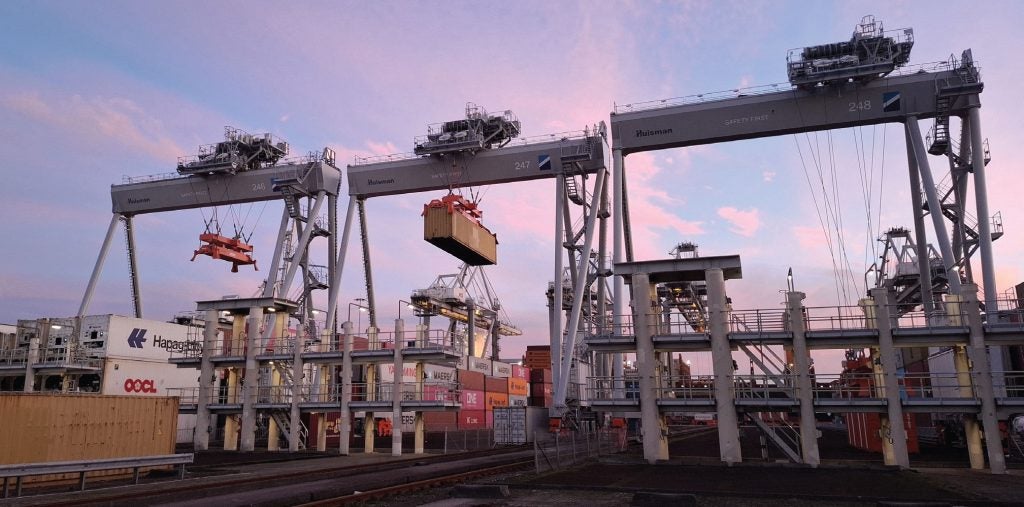
Huisman turned heads in January 2024 when it won a major order for its new automated stacking cranes (ASCs), from Hutchison Ports ECT Rotterdam (ECT). The tender required cranes that could carry out four million non-stop handling cycles over 30 years.
Growth opportunity
Its plan is to build on the success at ECT by winning tenders for similar projects, in Europe and North America. “We expect that ports and terminals will continue to automate and that will create more opportunities,” he says.
“The conversion of straddle carrier terminals to ASC terminals brings multiple benefits. They get to remove diesel equipment and replace with automated electric equipment – and that means even higher stacking density.”
In addition, the company manufactures a range of rail-mounted gantry cranes (RMGs) for yard and intermodal applications. “We are working to enter the RMG market, which of course is different to ASCs.”
He adds, “The company has a very clear long-term strategy to grow in this market. It is not without its challenges as the offshore industry is more about bespoke products – you are engineering to order. For the ports logistics products, we had to change to a more productionised mindset, so, thinking about standard products with the ability to customise them. We are making a lot of progress in this regard.”
The market has also responded positively to a new entrant. “Of course, some terminal operators are more conservative and want to see more specific experience first,” he says. “But many more are very receptive and open to seeing a new player in the market.
“Many told us that they do not want to put all their eggs in one basket. They want to diversify to ensure a healthy supply chain.” He also feels that the timing is right for a new European OEM. “Several companies dropped out of this market, including some from Europe,” he says. “So, a lot of terminal operators are pleased to see a new entrant that is based in Europe.”
Huisman also wants to play its part in driving safety and innovation in the industry. To this end, it has joined the Port Equipment Manufacturers Association (PEMA).
“I advocated for Huisman to join PEMA because it is a great forum for the industry,” he says. “It enables us to exchange views and information with colleagues, but also to really push the industry forward, together. That is the great strength of PEMA.
“With our background in the offshore industry, we are convinced that we can make a positive contribution to the ports sector. Offshore is even more safety-focused than the ports industry, so we hope we can bring a different perspective.”
Different approach
Arjan sees this safety focus as a key differentiator. “We come from an industry where safety is the number one priority. Safety is already at a very high level in the ports business, but we want to push it even further.
We also have the capability to adapt our products to meet the client’s specific needs.”
Feeding into both of those pillars is product quality. “We are trying to have more conversations around what high quality means for total cost of ownership (TCO),” he adds. “A higher quality crane will last longer and have much lower maintenance costs.”
And behind that, it is vital to have a strong service provision. “Some OEMs don’t have true global coverage, so that is a key differentiator for Huisman,” he says.
Major changes
Meijer is well-known in the industry, with over a decade of experience at companies such as Kalmar. A lot has changed since he started in this sector. “There has been significant growth in the size of container ships,” he says. “Every time the industry thinks it has settled on a new capacity, another bigger vessel comes along. They have gone from 20 containers wide to 26 or even more.”
Bigger ships mean higher volume and that has driven innovation in cargo handling.
“The vessel owners and operators want to be (un)loaded as quickly as possible, so port equipment productivity has increasingly crucial for terminal operators,” he adds.
At Kalmar, he was in his first years focused on rubber tyre gantry cranes (RTGs), which also underwent a major change during this time. “I witnessed the complete transition from hydraulic RTG to RTG with all-electric powertrain,” he says. “That was a step change in efficiency and helped to reduce the risk of oil leaks.
“After that, there was an intermediate step, using variable speed engines to improve fuel efficiency and reduce pollution,” he adds. “And of course, eventually we moved completely away from diesel to fully electric.
We went from hybrid cranes with battery packs to grid connected RTGs via cable reel and later also bus bar.”
Alongside that, he experienced the drive towards automation. “At first that was about remote control of RTGs, taking the driver out of the crane cab enabling supervised moves,” he says. “This continued with fully automated moves. The same then happened with RMGs and ship-to-shore (STS) cranes.”
Future plans
There is more to come from Huisman starting with new products. “We are planning to expand out portfolio later this year,” he says.
“We have a very positive view on 2026 with high expectations. We expect continuous demand from the market for port equipment to replace and convert existing operations.
There are perhaps fewer greenfield sites being developed after some very busy years but there are still a few out there.
“Global economic issues can impact things – last year we saw some projects postponed, for example. But in general, trade still continues and goods move around the planet. That will drive a steady flow of investment in this industry.
“For Huisman, we are still really at the beginning of our journey in port equipment. I am proud to be a part of the team that is shaping this new business for Huisman.”


